


Using data to make heat pumps more affordable in Anchorage

2026 ACEP summer intern Allison Bubar worked on a project that explored making heat pumps more affordable in Anchorage.
September 21, 2026
As a computer science, environmental studies and physics major at Oberlin College, Allison Bubar has a wide range of academic interests. She also loves the outdoors, so when it came time to choose where to spend her summer, Alaska was an easy choice.
This summer, Bubar found a way to combine those interests through research aimed at benefiting Alaska communities. She was excited to participate in the ACEP summer internship program and explore how data could help address one of Alaska’s energy challenges.
During her internship, Bubar studied how heat pumps could help reduce heating costs and natural gas use in Anchorage. Her work brought together data analysis, energy systems modeling and utility economics.
Heat pumps use electricity to move heat from one place to another to heat or cool a building. Under the mentorship of Michelle Wilber and in collaboration with other ACEP researchers, Bubar used real-world operating data to analyze how residential heat pumps perform.
She first modeled heat-pump efficiency under Anchorage’s varying weather conditions and estimated how that performance could affect natural gas consumption. She then analyzed Chugach Electric Association rate filings to better understand how utility rate structures could influence the economics of switching from fossil fuels to heat pumps.
Her goal was to explore whether changes in utility rates could make it more affordable for Anchorage residents to reduce emissions and heating costs through electrification, while also supporting the financial sustainability of the electric utility. This approach, in which electrification is designed to reduce emissions as well as costs, is often referred to as “beneficial electrification.”
The project strengthened Bubar’s technical skills in energy modeling and data analysis while giving her a deeper understanding of utility regulations and the economic factors that shape energy decisions.
Working with real-world heat-pump and utility data also reinforced the value of using research in informing practical decisions that can improve affordability and energy resilience in Alaska.
But what Bubar gained from the internship went beyond technical skills. The project broadened her perspective on the complexity of energy transitions and showed her that addressing an energy challenge often requires looking beyond the technology itself.
Space heating accounts for a large share of energy use in many Alaska communities. Improving heating efficiency could lower costs for residents while reducing demand for natural gas. But whether switching to heat pumps makes economic sense depends not only on the technology and its performance but also on electricity rates and utility policies.
Bubar came away with a new understanding of how these pieces fit together.
“Through this internship, I came to understand that successful electrification depends not only on advances in technology but also on thoughtful utility policies, economic considerations and the needs of the communities the systems serve,” she said.
The project also showed her how a well-designed solution could benefit multiple stakeholders.
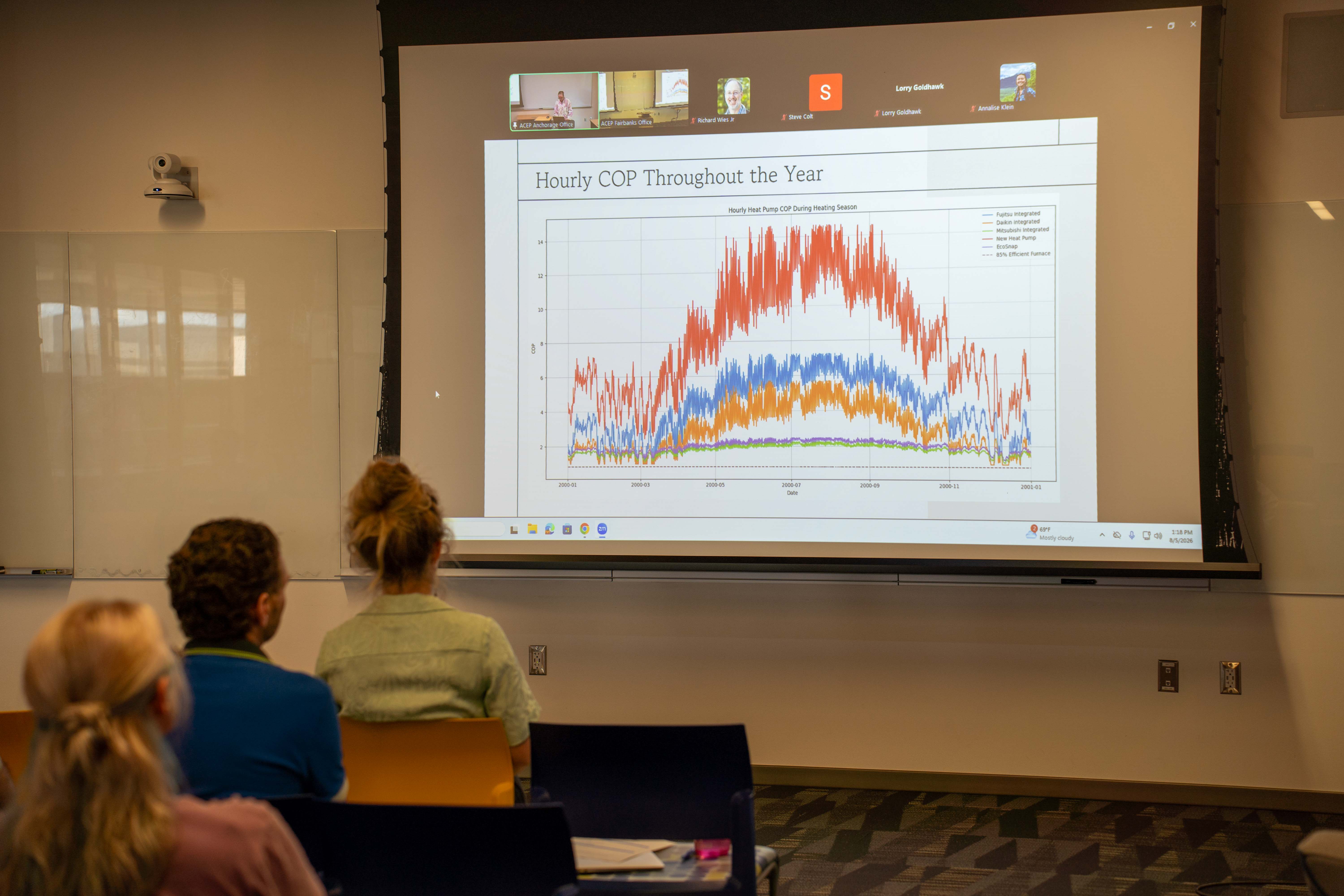
During her presentation via Zoom, 2026 ACEP summer intern Allison Bubar explains natural gas savings with a graph, showing how the efficiency differs among several heat pumps she researched in Anchorage.
“Thoughtful rate design could encourage heat pump adoption in a way that benefits both customers and the electric utility,” she said.
As additional real-world heat-pump performance data become available, the framework Bubar developed could be expanded to help researchers and utilities better understand how technology, rate design and economics can work together to make electrification more affordable in Alaska.
This internship was funded by the ACEP Undergraduate Summer Internship program. View the final presentation for this project on ACEP’s YouTube channel. For more information about this project, please contact Michelle Wilber at mmwilbur@alaska.edu.
This work relates to the Department of the Navy award N00014-24-1-2675 issued by the Office of Naval Research. Any opinions, findings, conclusions or recommendations expressed in this material are those of the author and do not necessarily reflect the views of the Office of Naval Research.