


Taking hydrokinetic energy from design to the field
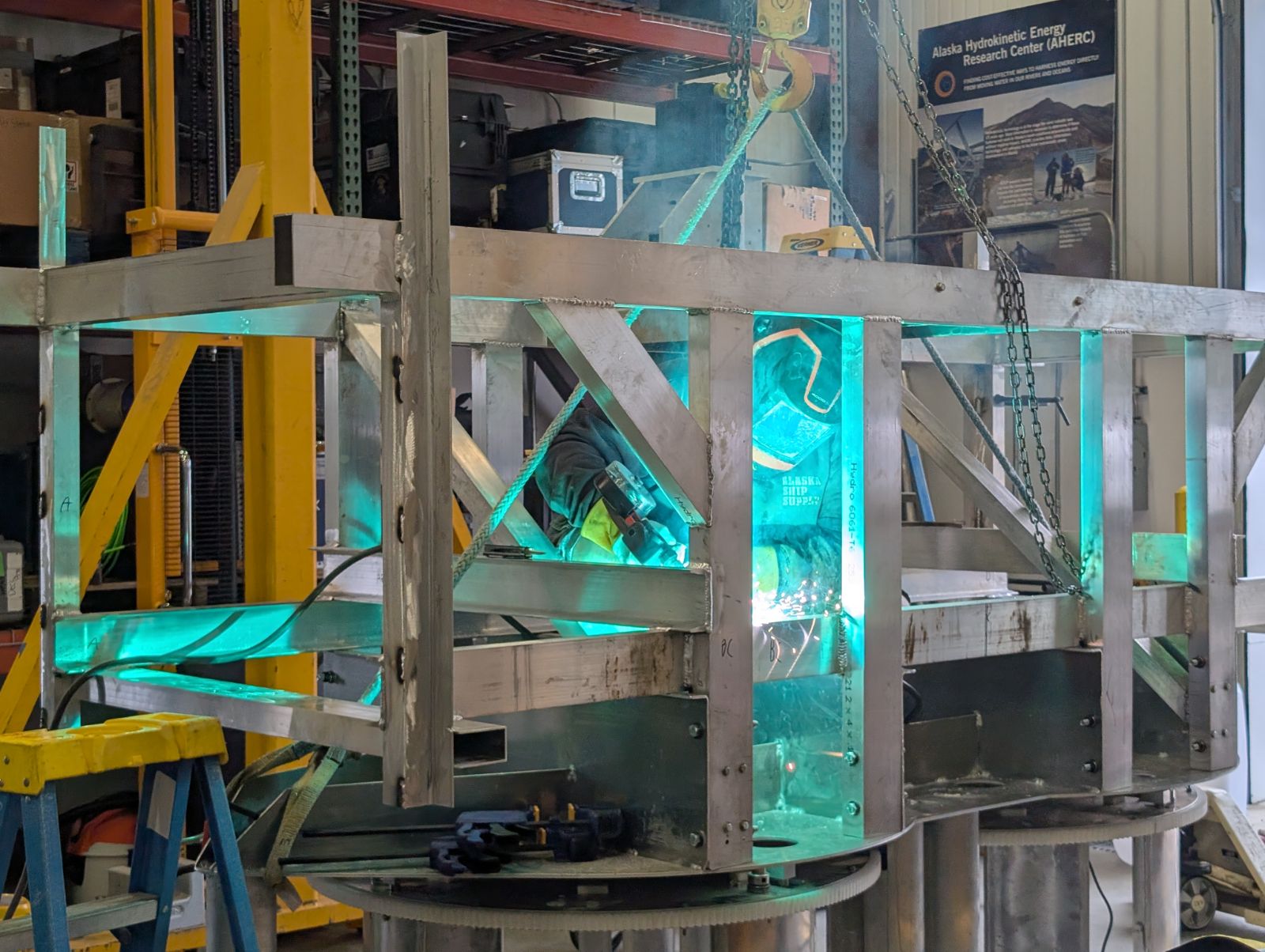
2026 ACEP summer intern Aidan Montague welds the support structure of the hydrokinetic turbine.
September 23, 2026
Houston, Texas, native Aidan Montague likes to understand how things work.
As a mechanical engineering major, that curiosity often takes him beyond simply learning how a device is designed. He wants to see the entire process — how an idea becomes something that can be built, tested and ultimately put to use.
He had the opportunity to do just that during summer 2026 in Alaska.
A mechanical engineering undergraduate at Texas A&M University, Montague participated in the ACEP summer internship program, working with ACEP’s marine energy team to test and assess hydrokinetic turbines at the Tanana River Hydrokinetic Test Site.
His work took him through many stages of the engineering process. He assembled and modified hydrokinetic turbines and their supporting systems, helped prepare them to collect field data and observed how they performed in the river.
Working closely with mentors on the marine energy team, Montague learned the practical skills, attention to detail and fundamentals needed to take an engineering concept from the lab to the field.
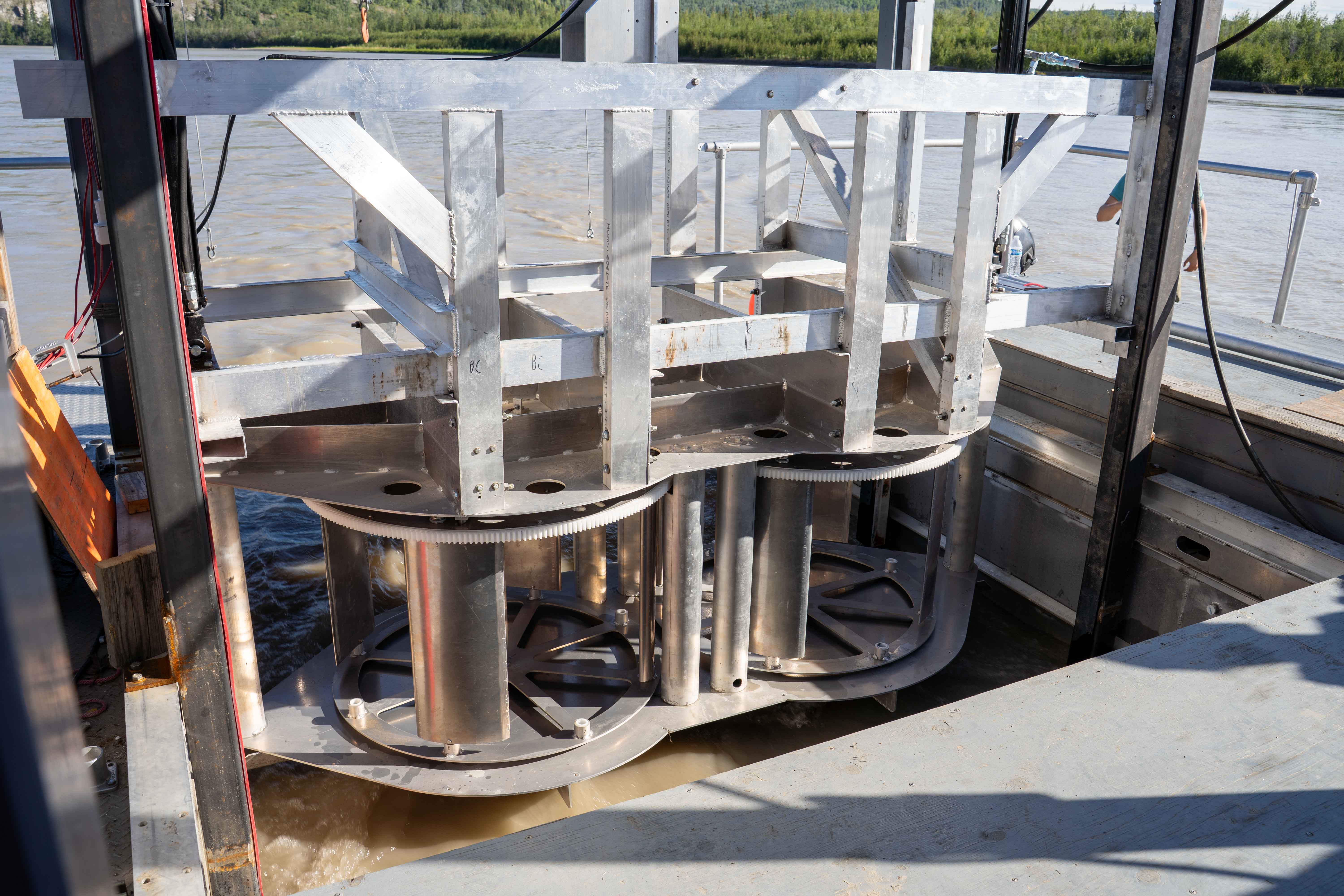
The hydrokinetic turbine that 2026 ACEP summer intern Aidan Montague worked on is ready to be tested at the Tanana River Hydrokinetic Test Site.
The experience offered Montague something a classroom alone cannot — the opportunity to see how the different pieces of an engineering project come together in the field.
“Having the opportunity to fabricate and weld a project that we tested was one of many highlights of my summer,” he said. “Seeing how much work and effort that is put into designing and testing these hydrokinetic systems was incredible.”
Located in Nenana, 55 miles from Fairbanks, the test site provides an environment for researchers to evaluate hydrokinetic technologies under actual river conditions. Hydrokinetic energy uses the natural movement of water, including currents, waves and tides, to generate power.
The work has particular significance for rural and remote Alaska communities, many of which rely on costly diesel fuel to generate electricity. If hydrokinetic technologies can be developed and tested to operate effectively in these communities, they could eventually provide another source of locally generated power and help reduce reliance on diesel.
That connection between engineering and its real-world application was an important part of Montague’s internship experience.
The turbines tested during summer successfully produced power, demonstrating that they are viable under real-world conditions. With continued research and testing, hydrokinetic power has the potential to become more common in remote regions. Montague believes this transition could become increasingly important as communities face challenges such as fuel costs and aging infrastructure.
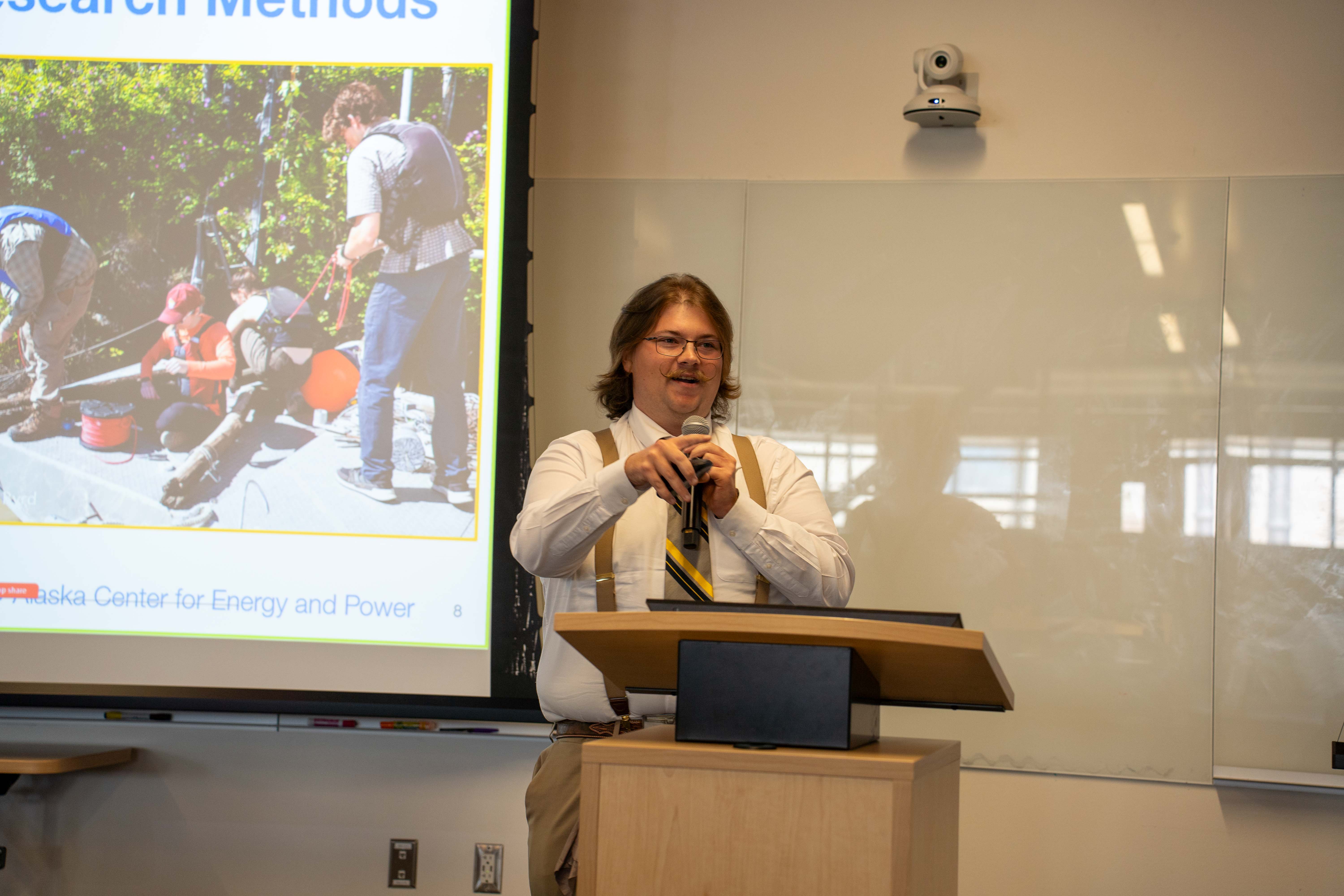
2026 ACEP summer intern Aidan Montague gives a presentation on his work on hydrokinetic turbines.
“These turbines could help offset the cost to powering homes, medical clinics and economic enterprises,” Montague said. “They can also assist government and municipal facilities like local businesses and schools.”
For Montague, seeing that process firsthand provided a glimpse of the kind of engineer he hopes to become — one who understands not only how something works but also how it can work for people.
“Getting the experience and opportunity to learn about hydrokinetic turbines, how a test site operates, and to see all the components that come together for a successful field campaign will undoubtedly be instrumental in my future as an engineer,” he said.
This internship was funded by the National Science Foundation through the ACEP Research Experiences for Undergraduates program. View the final presentation for this project on ACEP’s YouTube channel. For more information about this project, please contact Stephanie Fisher at sjump@alaska.edu.