


Preparing UAF’s power plant for the unexpected
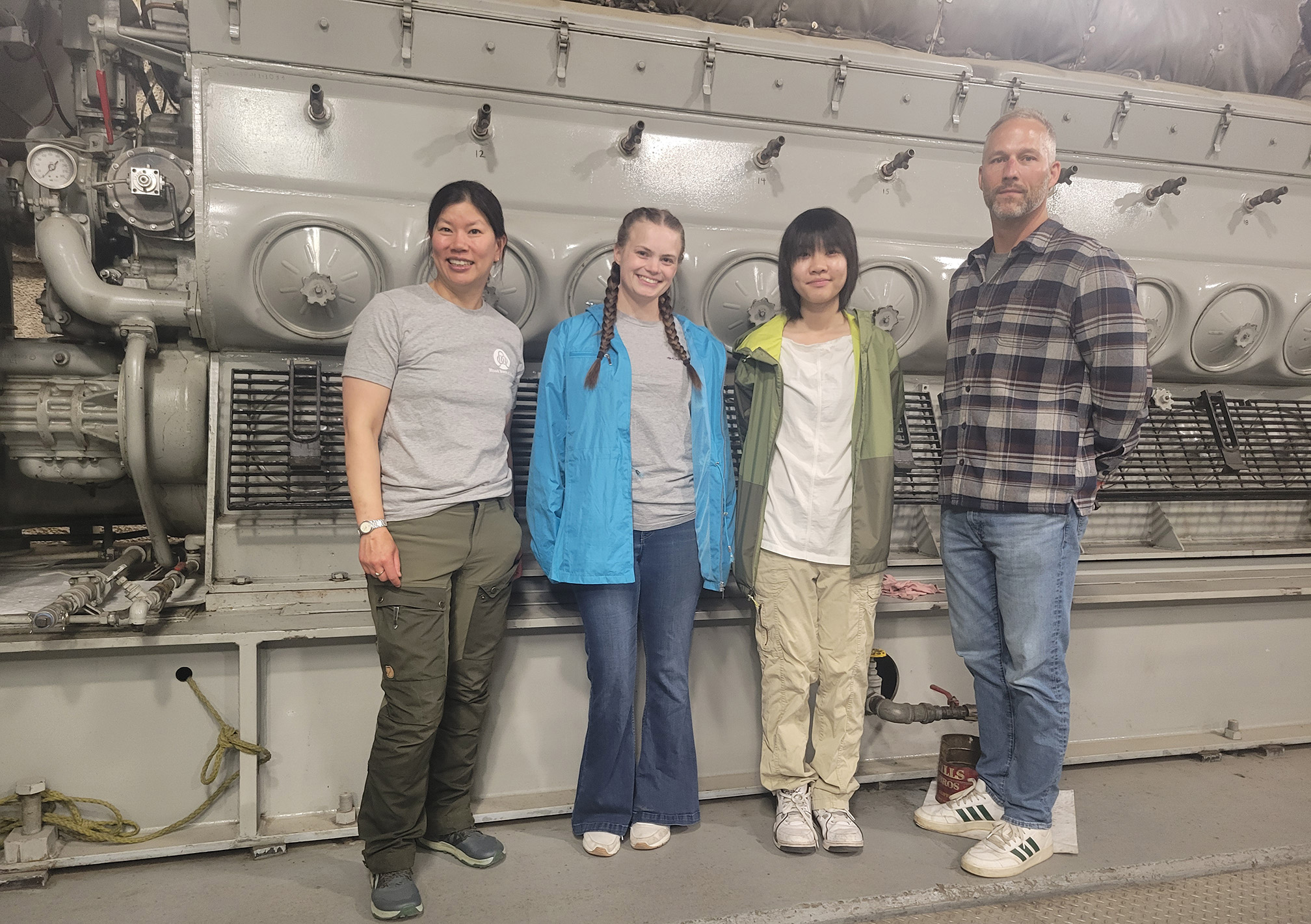
2026 ACEP summer interns Anna Beth Icke and Catelin Mo pose for a photo with their mentor Daisy Huang, far left, and GVEA’s gas turbine plant manager John Kelly.
September 24, 2026
On the University of Alaska Fairbanks Troth Yeddha’ campus, the combined heat and power plant, or CHP, provides heat and electricity to the entire campus. UAF can purchase power from Golden Valley Electric Association when necessary, and vice versa.
When the plant is operational, it can sustain itself. But what happens when the entire electrical grid goes dark?
Like many power plants, UAF’s CHP needs electricity to start and operate. If a large-scale event disrupted the intertie — an interconnection that allows electric utility systems to exchange power — and took both GVEA and the CHP offline, the campus would have no way to restart the CHP until GVEA returned to service. That could take hours.
ACEP summer interns Anna Beth Icke and Catelin Mo spent their summer researching how the CHP could be restarted following a large natural disaster without relying on the external power grid.
The process is known as a “black start” — restoring a power plant to operation without outside electricity after a total or partial shutdown. Adding a black-start generator to the CHP system could give the campus greater resilience and reduce long-term power-purchasing costs by allowing the plant to restart independently.
Icke and Mo jokingly referred to the project as their “zombie apocalypse” project. Under the guidance of Daisy Huang and Jeremy Kasper of the Alaska Center for Energy and Power, they researched and evaluated potential black-power solutions for the CHP. They conducted interviews and site visits with researchers and industry leaders to better understand the technical, financial and regulatory considerations involved in Alaska’s electric utility sector.
The two interns brought complementary backgrounds to the project. Icke is a recent graduate of the University of Alabama in Tuscaloosa with a degree in electrical engineering. Mo is a third-year mechanical engineering and mathematics student at the University of Texas at Austin. Icke focused on electrical interconnections and energy systems, while Mo worked on physical modeling.
Mo’s interest in the project was partly shaped by her experience during the 2021 power crisis in Texas caused by winter storms, which left more than four million people without power for several days. She wanted to learn how Alaska prepares for natural disasters. Although the two states have very different climates, she saw a similarity in their electric grids — neither is connected to the rest of the country through the continental U.S. grid.

2026 ACEP summer interns Anna Beth Icke, left, and Catelin Mo researched how to restore UAF’s power plant to operation without relying on the external power grid following a large natural disaster.
The project also gave the interns a broader view of the energy sector beyond engineering.
For Mo, who studies energy systems, the focus on energy and thermal systems was a natural fit. But she particularly valued the opportunity to consider the human sides of the industry.
“This project also dealt with other aspects like financial considerations, regulations and utility people, the real people who work in the industry,” she said.
The interns also encountered challenges that extended beyond the technical aspects of designing a black-start system. Funding remains a persistent barrier to electric utility development in Alaska, and it can be difficult to engage people who are already focused on managing day-to-day operations around the clock in planning for a hypothetical scenario that has never occurred.
Their study reinforced the importance of careful financial assessment and optimization as energy costs fluctuate, particularly when considering investments intended to improve both energy efficiency and reliability.
For Icke, the project provided a new perspective on Alaska’s energy systems.
“Power systems up here are truly different from those anywhere else in the country,” she said. “And it’s been amazing to learn about the advantages and challenges that come with them.”
She also credited Alaska’s culture with contributing to the experience.
“People embrace the summer while it lasts and do as much as possible while the days are long,” she said. “I feel like that culture of energy and enthusiasm made my depth of learning possible in such a short period of time.”
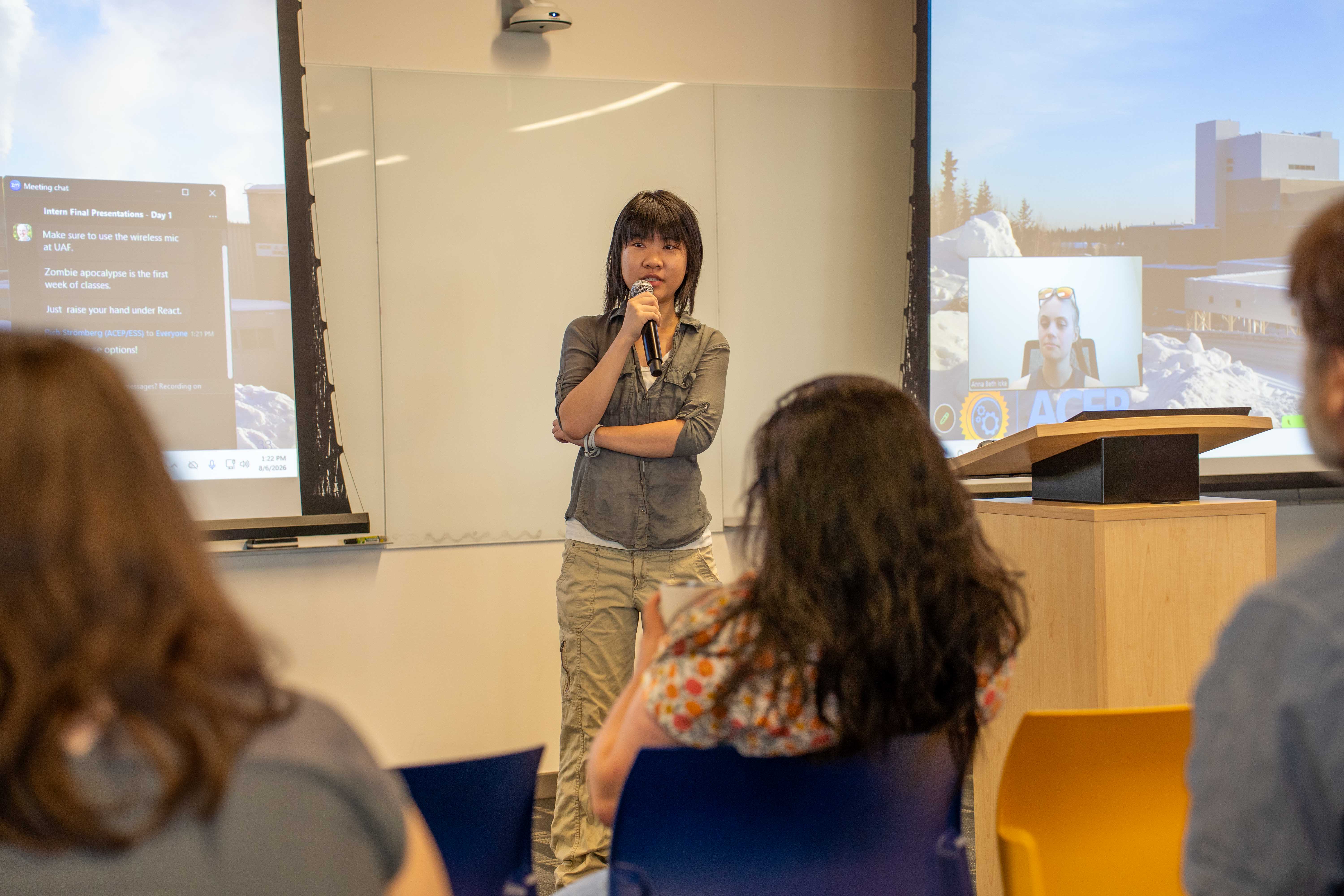
2026 ACEP summer interns Catelin Mo, on mike, and Anna Beth Icke, on screen via Zoom, answer questions during the presentation on their research.
Mo came away with a similar appreciation for Alaska’s resilience. She was struck by the way Alaskans respond to challenges with resourcefulness and a strong sense of community — qualities she also saw reflected in the energy research at ACEP with its partners.
“People in Alaska are the toughest people I’ve seen because if things go wrong, they just go fix them,” she said. “There’s a strong community here. And people don’t let anything go to waste.”
That resilience, she said, is something she hopes to take home with her to Texas.
This internship was funded by the ACEP Undergraduate Summer Internship program. View the final presentation for this project on ACEP’s YouTube channel. For more information about this project, please contact Daisy Huang at dhuang@alaska.edu.
This work relates to the Department of Navy awards N00014-22-1-2049 and N00014-24-1-2675 issued by the Office of Naval Research. Any opinions, findings, and conclusions or recommendations expressed in this material are those of the author(s) and do not necessarily reflect the views of the Office of Naval Research.