


2026 Research and Creative Activity Day
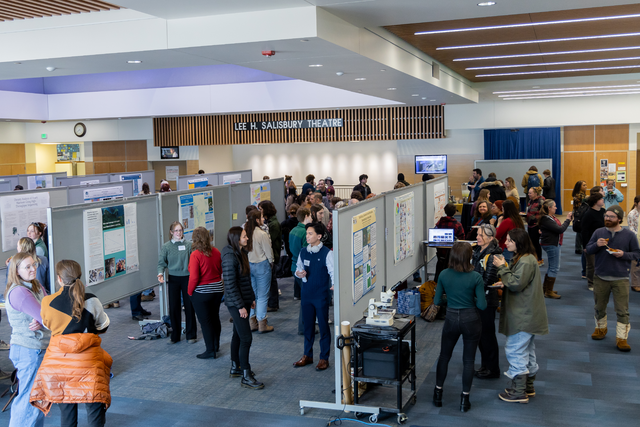
The 2026 RCA Day was held in The Great Hall, Fine Arts Complex. Photo credit: Brian Choi
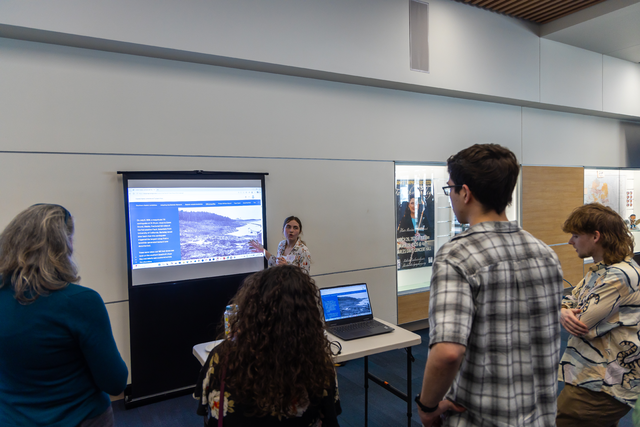
Chloe Crossen, undergraduate student, presents her slideshow Map-based Storytelling: Communicating the Risks of Landslides and Tsunamis Along Alaska's Southern Coast. Photo credit: Brian Choi
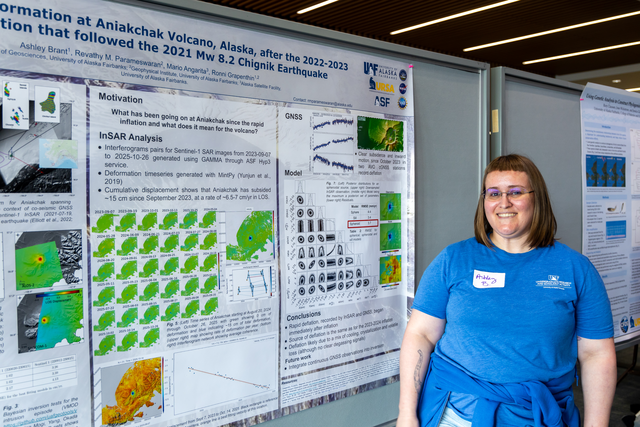
Ashley Brant, undergraduate student, presents her poster Reversal in Deformation Signal at Aniakchak Volcano in Alaska Following the 2021 Mw 8.2 Chignik Earthquake. Photo credit: Brian Choi
Slide 1
Slide 2
Slide 3
| Presenter | Project |
|---|---|
| Alex Armstrong, Mark Hermano, Blake Bushnell, Kassidy Barclay |
Mentor: Dr. Michael Hatfield The University of Alaska Fairbanks Aeronautics Club will be participating in the 30th annual Design/Build/Fly competition in Wichita, KS. Teams are tasked with designing an electrically powered, remote controlled aircraft to perform a specified mission under specified constraints. |
|
Alex Cater, Griffin Marson, Ryma May
|
Mentor: Dr. Achille Capelli The Magnaprobe Modernization project replaces a bulky backpack-mounted datalogger with fully integrated on-rod electronics, creating a self-contained Arctic snow-depth instrument. Using an ESP32 microcontroller, 24-bit ADC, 10 Hz GNSS, and 9-axis IMU, the redesigned system achieves 1 mm resolution and less than 5 mm accuracy while operating down to −40 °C. |
| Chris Parker |
Mentor: Dr. Richard Wies Wi-Fi based object detection using three transmission devices centered around a central receiving station.
|
|
William PayneIssac Newton, Nadezhda Finley |
Mentor: Dr. Michael Hatfield The project is a lightweight, portable antenna rotator designed for satellite tracking and terrestrial connections. The rotator, powered by a Raspberry Pi, integrates Gpredict software and Maidenhead coordinates. It will be tripod-mountable, weigh under 10 pounds, and be built to operate reliably in temperatures from -40°F to 120°F. |
| Nathen Scott |
Higher Temperature & Low Chlorine Residuals are Associated with Increased Legionella Concentrations Mentor: Dr. Theresa Miller This project evaluates how water quality conditions in a treated distribution system influence the occurrence of Legionella pneumophila. Monthly sampling, field measurements, and Legiolert assays were used to characterize chlorine residuals, temperature, and plumbing conditions across facilities, providing a framework for understanding factors that shape microbial behavior in building water systems.
|
| Presenter | Project |
|---|---|
|
Rory Claussen
|
Using Genetic Analysis to Construct Phylogenies of Arctic Fish Species Mentor: Dr. Jessica Glass The goal of this project was to analyze evolutionary relationships among Arctic fish species by constructing phylogenetic trees. This was done by using DNA extraction, PCR amplification, sequencing, and data analysis. Understanding phylogenetic relationships is important because characterizing biodiversity and evolutionary patterns helps future conservation efforts for these species. |
| Presenter | Project |
|---|---|
|
Alexia Devine MariAna Beks Olivia Buzby Kevin Clark Grace Farrell Jack Helmericks |
UAF Music: Costa Rica May 2025 Mentor: Dr. Jaunelle Celaire In May of 2025, UAF Music students had the chance to travel to Costa Rica to perform Bastienne und Bastien, a one act opera composed by Mozart, as well as scenes from other operatic works by the same composer, at the University of Costa Rica. |
|
Rafaela (Sophie) Hertkorn-Haas Britan Wallace Sophia Wilcox |
Mentor: Dr. Inna Rivkin We highlight findings of several partnerships with rural Alaska Native communities supporting youth wellness through intergenerational storytelling. Youth learned from Elders, connected with traditions, and created and shared digital stories. We discuss the value of opportunities for youth to celebrate culture, share narratives, and build identity, community support, and wellness. |
|
Cirrus Jones |
Mentor: Dr. Kristy Bowen On going research of the possible effect social media has on empathy. |
|
Peter Lowe |
Mentor: Dr. Inna Rivkin This project explored students' transition from a rural community to university, focusing on challenges students faced, what promotes student success, and benefits of Rural Student Services at UAF and Indigenous & Rural Student Center at UAA. The goal was to determine the best strategies to address rural and Indigenous student's needs. |
|
Natalie Milburn |
Democracy at Work: A Qualitative Study of Organizational Culture in Worker Cooperatives Mentor: Dr. Kevin Walters Worker cooperatives are a rising form of organization which are employee-owned and democratically run. Despite this, research on these organizations is minimal. This project uses Hofstede’s Cultural Dimensions Model as a framework to conduct thematic analysis of semi-structured interviews and to research the organizational culture within worker cooperatives. |
|
Jillian Muni |
Sustainable Glazing with Alaskan Fly Ash Mentors: Dr. Teresa Shannon Experimental testing of utilizing coal byproduct as a source of ceramic glaze material |
|
Paradise Porter |
Impacts of the Current Federal Administration on Social Service Agencies in Alaska Mentor: Dr. Retchenda George-Bettisworth A project aimed to explore potential current and long-lasting impacts health and social service agencies across the State of Alaska may be experiencing as a result of policies and actions implemented by the current federal administration. |
|
Margaret Thomas Amanda Kurka Malinda Vinloo Katina Whisel |
Ice Box: Reviving the Undergraduate Club Mentor:Dr. Joe Holt Ice Box history and description of club activities over fall 2025
|
| Presenter | Project |
|---|---|
|
Pirada Anderson |
The Effects of Rising Temperatures on Trichobilharzia alaskensis Shedding in Freshwater Snails Mentor: Dr. Don Larson This project examines the impacts of rising temperatures on trichobilharzia alaskensis. T. alaskensis is a parasite that infects a snail and a duck. T. alaskensis causes the disease swimmer's itch, a pustulous rash. We found that the rate of parasite shedding from freshwater snails increases with temperature. |
|
Linnea Beauchamp |
Mentor: Dr. Brian Rasley This project evaluates quaternary amine–functionalized polyHIPEs for removing PFAS from drinking water. By varying common water ions and ionic strength, adsorption performance and pore morphology will be analyzed using LC-MS and SEM to understand ion competition and optimize PFAS removal under realistic water conditions. |
|
Blake Chrisler |
Red Fox Diel Activity In and Around Fairbanks Mentor: Dr. Ellen Candler This project was completed along with Dr. Ellen Candler last summer, where we set up three grids of cameras in different human densities around Fairbanks. The cameras were out for one month, and when collected images were analyzed for species. I then used this data to compare red fox diel activity in correlation with human population density. |
|
Ellie Kanz |
The Effect of Crystal Orientation on the Raman Spectra of K-Feldspar Polymorphs Mentor: Dr. Marisa Acosta There are three types of K-feldspar: microcline, orthoclase, and sanidine. These minerals share the same chemical composition (KAlSi3O8) but differ in crystalline structure. I compared multiple Raman spectra of single crystals to determine if Raman can be used to reliably differentiate between these chemically identical but structurally unique minerals. |
|
Michael Maloy Hayden Mullikin Lillian Downing |
Mapping the Severity of the Spruce Beetle Outbreak in the Alaska Range Mentor: Dr. Katie Spellman This project maps the expansion of Spruce Beetle outbreaks in the Alaska Range using Sentinel-2 and Maxar satellite imagery. By analyzing shortwave infrared reflectance to detect vegetation stress, a model produced an infestation severity map between Healy and Cantwell, providing stakeholders with baseline data to manage impacted forests.
|
|
Cooper Moen |
Mentor: Dr. Katie Spellman This project looked at the relationship between Vaccinium fruit production and the insect damage caused by herbivory. Using an 18m transect, sampling every 2m. Blueberry production varied significantly by year of last wildfire burn, but damage to the leaves from insect herbivory did not.
|
|
Ryan Owens |
Mentor: Dr. Zach Cureton-Hazard An optical chemical analysis of chromophoric dissolved organic matter from headwater streams that fall across changing permafrost terrain. |
|
Ainsley Sauer |
Iron Export from Permafrost Influenced Streams in the Fairbanks Area Mentor: Dr. Sarah Ellen Johnston Due to globally increasing temperatures, water quality is changing in Arctic aquatic networks. Permafrost thaw is causing “rusting rivers” in the Interior due to the thaw discoloring waterbodies. My research focuses on gathering baseline data for iron concentrations and various water quality parameters, including pH, conductivity, and turbidity. |
|
Sable Scotton |
American marten (Martes americana) as Indicator for Alaskan Microplastic Contamination Mentor: Dr. Marianne Lian This project aims to investigate the relationship between microplastic particle concentrations in American marten and their proximity to human infrastructure (roads, cities, etc.)
|
|
Dorothy Sherer |
Movement Ecology of Lynx Along the Dalton Highway in the Southcentral Brooks Range Mentor: Dr. Knut Kielland Through this project, I investigated lynx spatial ecology based on GPS collar data from the Brooks Range, Alaska. I used statistical analysis to examine patterns of movements of lynx in the Dalton Highway corridor in relation to vehicle traffic in an attempt to evaluate their attraction or avoidance of the road. |
| Presenter | Project |
|---|---|
| Ashley Brant |
Mentor: Dr. Revathy Parameswaran Aniakchak volcano in the Aleutians experienced unrest and a ~80cm inflation in 2022-2023 following 2021 the Mw 8.2 Chignik earthquake, triggering a temporary yellow advisory alert for the volcano. This project monitors and quantifies the deformation at Aniakchak after the inflation episode. |
| Chloe Crossen |
Map-based Storytelling: Communicating the Risks of Landslides and Tsunamis Along Alaska's Southern Coast Mentor: Dr. Elisabeth Nadin This project reports the risks of unstable slopes and their associated tsunami hazards along Alaska’s southern coast. It outlines the ongoing landslide monitoring efforts by the Alaska Earthquake Center and other agencies to create an engaging ArcGIS story map that improves safety and awareness within communities. |
| Michael Maloy |
Bidarkis Respond to Intertidal Algal Cover: Implications for a Changing Climate Mentor: Dr. Simon Zwieback This study examined how algal cover and substrate temperature affect Bidarki chiton (Katharina tunicata) abundance at two sites. At Jakolof Bay, chiton numbers declined as algal cover increased, possibly due to competition or sea otter predation. No significant relationship was found between abundance and temperature, suggesting some climate resilience. |
|
Lee Aeo Alex Patton |
Dating The Movements Of The Denali Fault Mentor: Dr. Florian Hofmann A poster presented by Lee Aeo and Alex Patton discussing the vertical fault movements of certain areas within the Denali Fault using thermochronology. |
|
Teegan Silva |
Spatiotemporal Variability in Seasonal Velocity Drivers at Sermeq Kujalleq, Greenland Mentor: Dr. Amy Jenson I analyzed open-source satellite imagery data to investigate how seasonal changes in terminus position, runoff, and glacier velocity interact at Sermeq Kujalleq, one of Greenland’s fastest-flowing tidewater glaciers. Understanding these dynamics will improve predictions of future ice loss and sea level rise from the Greenland Ice Sheet. |
| Presenter | Project |
|---|---|
| Caden Albright |
Antibiotic Resistance, Biofilm Formation, and Their Association with Medical Implants Mentors: Dr. Mario Muscarella An experiment conducted to understand what, if any, relationship there is between medical implant presence, how much resistance to antibiotics is developed, and how much biofilm is formed. |
|
Owen Averett |
Mentor: Dr. Kristin O'Brien Quantifying histone methylation changes in response to hypoxia in antarctic and cold-temperate fishes using capillary based western blotting. Oxygen sensitive methylation sites like K4, K9, K27, and K36 where probed for in normoxic and hypoxic fish tissue samples and their amounts normalized to H3 levels. |
|
Larrisa Barreiros Scatamburlo |
The Seasonality of Juvenile Arctic Char (Salvelinus alpinus) Energetics in the Canadian Arctic Mentor: Dr. Matthew Gilbert This project analyzed the seasonality of juvenile and adult Arctic char energetics between summer and winter seasons. Comparisions of body masses and organ weights of juvenile and adult Arctic char expressed significant seasonal discrepancies in adults while minimal organ size differences in juveniles. |
|
Amina Downs |
Dietary Analysis of Hoary Marmots Using High-Throughput Sequencing Mentor: Dr. Diana Wolf My poster details our comprehensive study of the diet of Alaskan Horay Marmots. This is the first study of its kind which aims to better develop our understanding of the diets of North America's largest ground squirrel in times of rapidly changing environments and depleting resources. |
|
Mark Durango |
Mentors: Dr. Kristin O'Brien My project examines hypoxia tolerance in Antarctic fishes by comparing anaerobic metabolic capacity (Lactate dehydrogenase [LDH] activity) with their temperate relative, Eleginops maclovinus. The results show Antarctic species do not increase LDH activity under hypoxia and exhibit higher baseline activity, suggesting LDH does not explain their lower hypoxia tolerance. |
|
Samantha Medbury |
Exploring the Neural Mechanisms of Hibernation in Arctic Ground Squirrels Through AAV Gene Delivery Mentor: Dr. Kelly Drew The Arctic ground squirrel survives extreme cold by hibernating from August to April. During torpor, body temperature can fall to −3 °C and metabolism slows dramatically. Periodic interbout arousals briefly restore physiological balance. This project develops AAV gene delivery tools to study the neural circuits controlling hibernation in this non-model species. |
|
Nivedita Menon |
Sex-based Differences in Metabolic Proteins During Metabolic Suppression in a Human-sized Hibernator Mentors: Dr. Sarah Rice This poster presents preliminary results on sex-based differences in metabolic proteins from spring emergence black bear tissue samples, using data that has been collected over the past year, as well as a previously-unanalyzed proteomics dataset. |
|
Sarah Nyland |
Establishing a Baseline for Post-Restoration Biomonitoring in Nome Creek Mentors: Dakota Keller This poster will present a comparison of macroinvertebrate communities in two unrestored stream reaches. I'll mention project goals, methods, and results for the samples processed so far. My discussion will highlight the significance of what's been completed so far, and plans for the rest of the project. |
|
Stella Organek |
Mentors: Dr. Sarah Rice This opportunistic Mount Rainier study aimed to understand hydration assessment and status of climbers on Mount Rainier. In-field hydration assessment methods including urine color, urine output and dehydration symptoms, were analyzed relative to classical measurements of hydration to understand their feasibility and accuracy. |
|
Noah Pereira |
Individual Variation in Moose (Alces alces) Movement in Response to Predator Densities Mentors: Dr. Greg Breed This project uses GPS collar data to investigate how individual moose respond to the presence of predators on the landscape. By focusing on movement patterns and variation of individuals, we're able to examine how some moose change behavior based on increasing or decreasing predator presence. |
|
Gabriele Riguado |
Liver Glycogen Metabolism Differs Among Antarctic and Cold Temperate Fishes in Response to Hypoxia. Mentors: Dr. Kristin O'Brien The goal was to measure liver glycogen levels in Antarctic fishes and a cold-temperate relative and compare differences between normoxic and hypoxic acclimated groups. |
|
Amelia Wagner-Jones |
Thermal Acclimation Potential of Juvenile Alaska Chinook (Oncorhynchus tshawytscha) Mentors: Dr. Matthew Gilbert This study sought to assess the cardiac function and thermal sensitivity of juvenile Alaskan Chinook with acclimation temperature and the responding effects to cardiac function under acute thermal stress. |
| Presenter | Project |
|---|---|
| Ruben Rhodes |
From Fresh to Salt: Tracking the Salinity Gradient in Kasitsna Bay's Intertidal Zone Mentor: Dr. Katie Spellman Salinity gradients along the Kasitsna Bay, Alaska intertidal zone are not affected by tide height, but shift significantly with the ebb and flow tides. Studying these freshwater-saltwater mixing zones can improve our understanding of salinity gradients and their impacts as freshwater inputs increase across Alaska. |
|
Soka Vanegas-Farrarra |
Diverse Habitats Support Resilience in Rubus idaeus Pollination and Fruit Production Mentor: Dr. Katie Spellman This project investigates how habitat diversity influences pollination and fruit production in raspberries (Rubus idaeus) in Alaska. By comparing wild and cultivated patches, it explores how environmental variation affects flowering timing, pollinator activity, and overall productivity to better understand resilience in northern food systems. |
| Presenter | Project |
|---|---|
| Nicole Young |
Mysteries of the Museum: Backlog Investigation, Management, and Resolution Mentor: Della Hall My project will take viewers through the steps in managing museum backlog. Beginning with the initial question, research, evaluation, more research, and determining the best solution, whether it is to be added to the museum’s collection or sent to a more appropriate home and what both of those options entail. |