


New report offers insights into Railbelt net metering capacity expansion
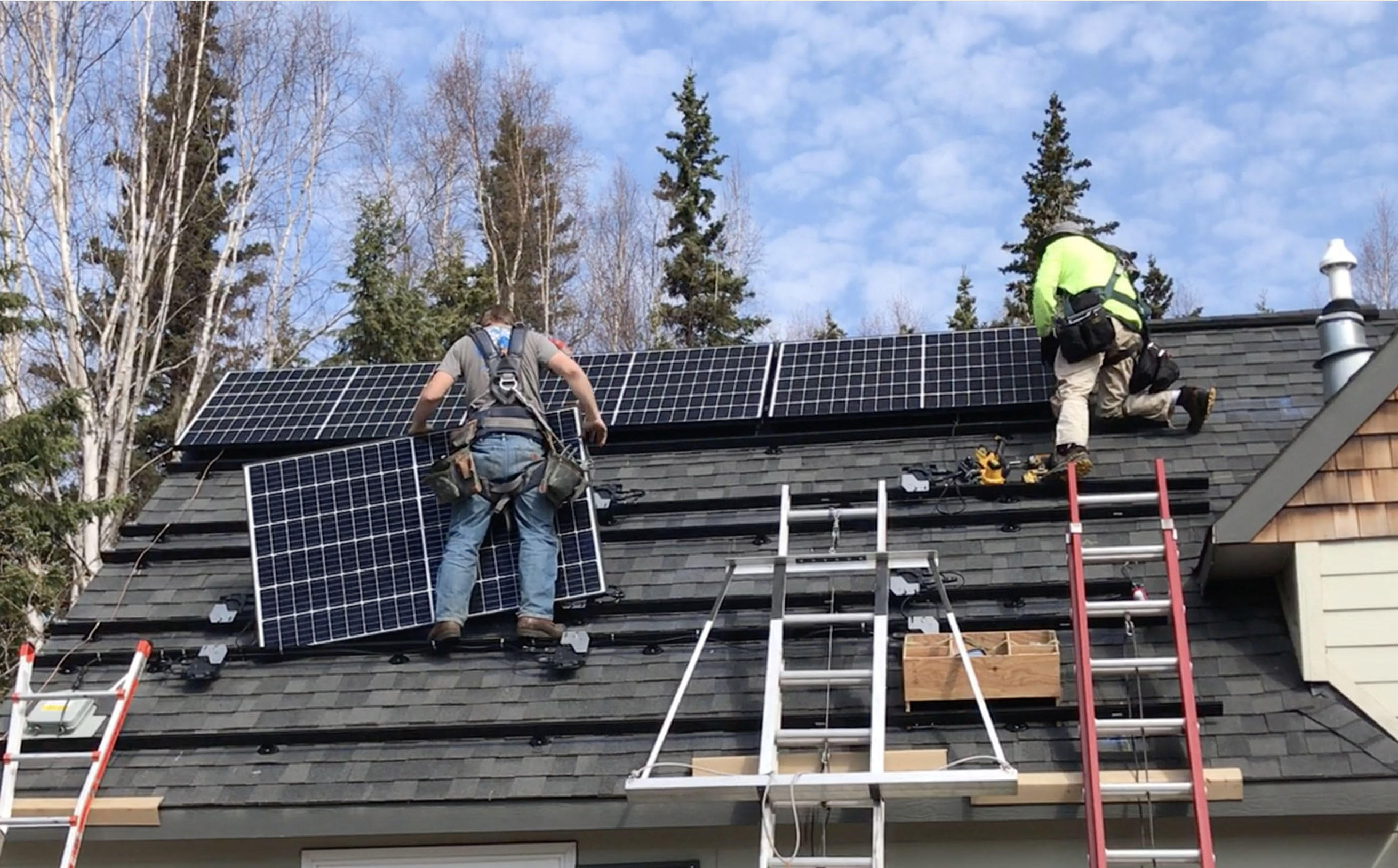
Workers install solar panels on a homeowner’s rooftop in Anchorage.
January 13, 2026
In recent years, Alaska has seen an increase in installation of small-scale energy systems close to where the energy is used, such as solar panels on a homeowner’s rooftop.
A new report summarizes the growth of such installed net-metered distributed generation capacity across the Alaska Railbelt during 2024 and provides an essential look at the evolving energy landscape. The Alaska Railbelt is a critical 700-mile-long transmission corridor connecting Fairbanks, Anchorage and Homer.
The 2025 Alaska Railbelt Net Metering Update, authored by ACEP’s Kate Modler and Chris Pike, offers valuable data and insights into the rapid expansion of net metering capacity for anyone interested in renewable energy policy, distributed generation trends and grid modernization in Alaska.
Key highlights include:
- A summary of the total growth of net-metered distributed generation capacity in the Railbelt.
- Data compiled from official 2024 utility filings to the Regulatory Commission of Alaska.
- An analysis focusing on the key energy corridor spanning the state's major population centers.
Since 2020, ACEP has published an annual net-metering update for the Railbelt.