


Apply now: New summer courses on community-based energy
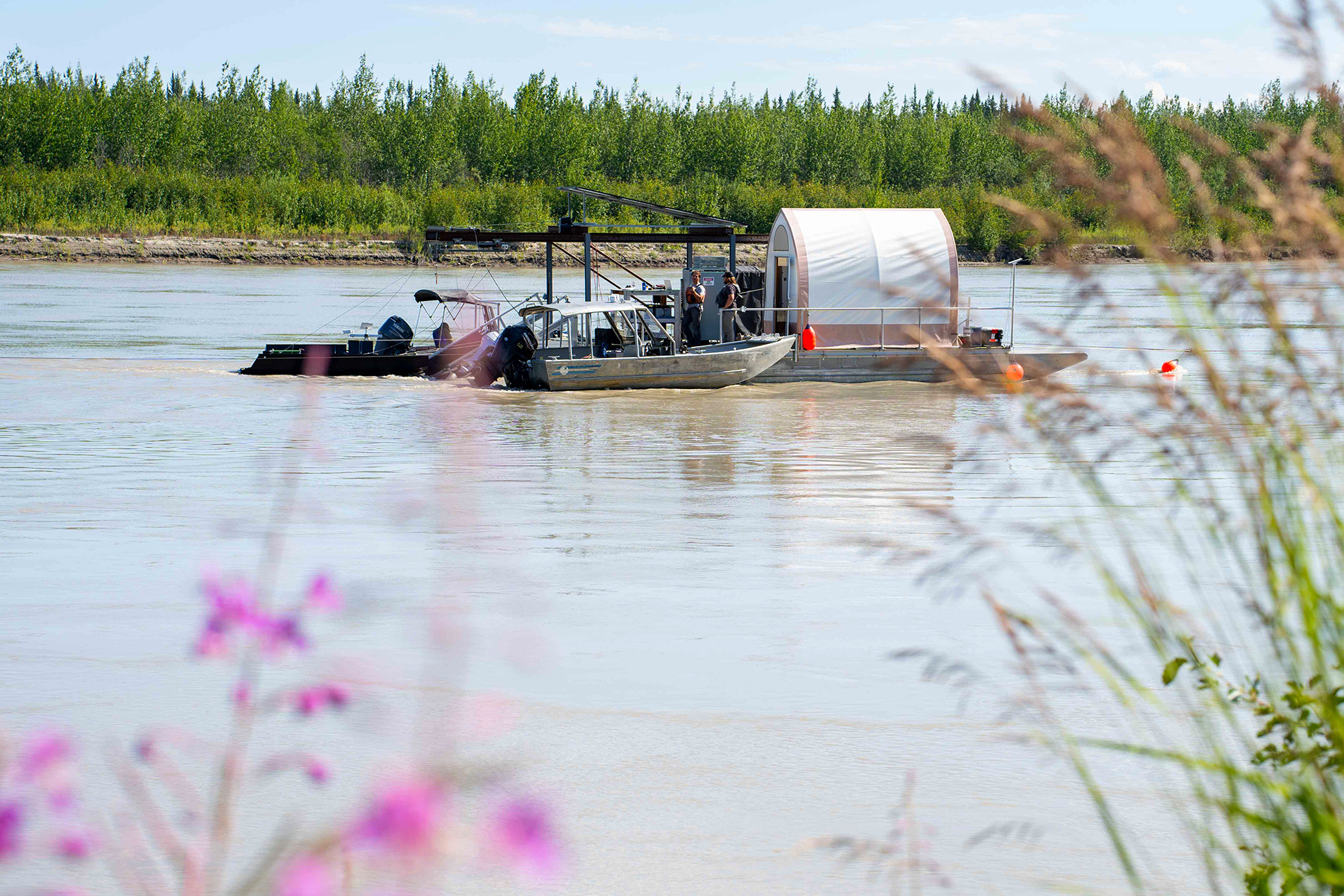
ACEP’s marine energy team conducts research at the Tanana River Hydrokinetic Site in Nenana.
February 12, 2026
The Alaska Center for Energy and Power is accepting applications for two week-long, community-based energy intensive courses taking place in summer 2026. This opportunity is for UAF undergraduate students.
Offered in partnership with the UAF Climate Scholars Program, these courses are designed for students interested in how energy systems intersect with community priorities, culture and the environment. Students from engineering, science, policy and social science backgrounds are encouraged to apply. Tuition and all travel fees are covered. Limited space is still available for the summer 2026 intensive courses. Complete the interest form to stay informed about upcoming short courses and to apply for a course offered this summer.
Both courses emphasize learning from researchers, utility professionals and community members, giving students firsthand insight into how energy projects are developed and implemented in real-world settings.
- Community Energy Planning in Galena
Dates: Monday-Friday, May 4-8
Apply here.
This intensive course examines the relationship between energy research and community energy planning in rural Alaska, with a focus on off-road microgrid communities. Students will explore the unique challenges and opportunities these communities face, using Galena as a case study.
Galena’s energy system was shaped in part by infrastructure left behind from a former military base, which enabled the community to develop a comprehensive energy plan focused on long-term security and reliability. Today, Galena continues to evaluate options for integrating renewable resources, such as biomass, solar and river energy, into a diesel-based microgrid. This work requires balancing technical considerations with cultural values and community priorities, including those of tribal organizations, local governments and subsistence users.
Students will engage with community leaders and energy researchers to better understand how technical, economic and cultural factors come together in the design of inclusive and sustainable energy solutions. The course equips students with practical skills in listening, collaboration and community engagement that are essential for working on rural energy projects in Alaska.
- Introduction to Marine Energy
Dates: August 2026 (exact dates to be announced)
Apply here.
Marine energy is an emerging field focused on generating power from waves, tides, currents and rivers. Marine hydrokinetic, or MHK, technologies are “in-water” systems designed to capture energy from moving water with minimal disruption to natural flows. These technologies are of growing interest to coastal and river communities seeking to reduce reliance on fossil fuels and increase local energy independence.
Effective community energy planning requires accurate assessments of available marine resources as well as testing to ensure that MHK systems perform reliably, especially in remote locations. This intensive course introduces students to the data collection methods used in marine energy resource assessments and provides hands-on experience observing MHK testing at the Tanana River Hydrokinetic Test Site in Nenana, a UAF-operated facility.
The course also emphasizes respectful community engagement and follows the UAF Guiding Principles for working with Alaska Native and Indigenous communities.
Students in both courses will have opportunities to continue their involvement through ACEP internships, research projects or senior capstone work. Students interested in applied, community-focused energy work are encouraged to apply.
These courses are funded by a National Science Foundation Improving Undergraduate STEM Education grant, “Developing Next-Generation Engineers through Resilience Intensives and Mentorship” (#2439826). For more information, contact Annalise Klein Gerlach or visit the UAF Climate Scholars Program website.