


New engineering professor aims to revolutionize energy solutions for Alaska’s remote communities
December 4, 2025
By Yuri Bult-Ito
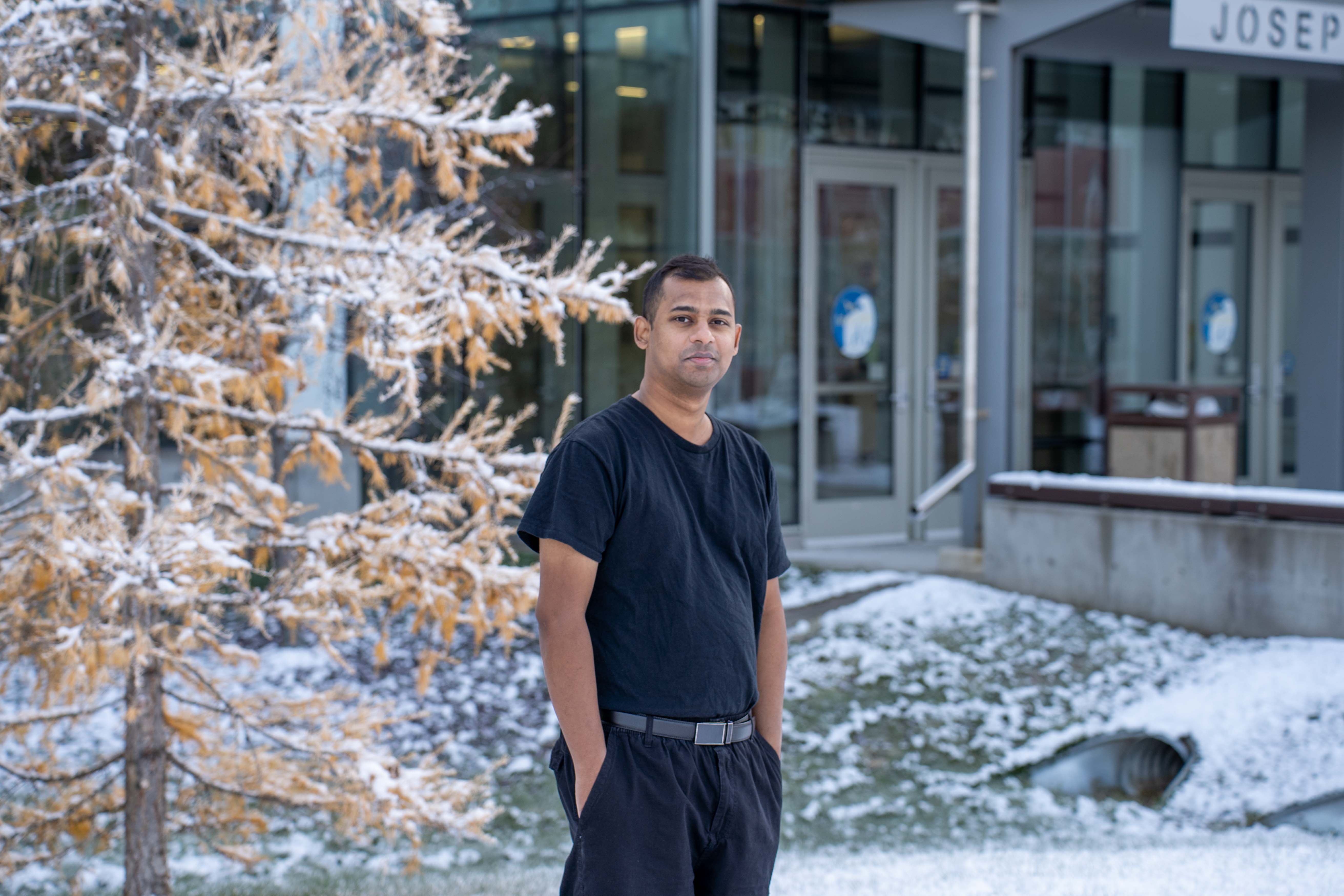
Sreedev Das is an assistant professor of mechanical engineering.
In Alaska, where winter temperatures can plummet to below -40F and communities are often isolated from the power grid, reliable energy isn’t just a convenience. It is a necessity.
Sreedev Das is tackling this challenge head-on. His work in thermal science is focused on improving energy systems that can withstand the harsh conditions of remote Alaska communities, making them more efficient, reliable and sustainable.
Das joined ACEP in August as an assistant professor of mechanical engineering. He has a joint appointment with the UAF College of Engineering and Mines.
Das brings a wealth of experience in mechanical engineering and thermal energy systems. He is committed to solving some of Alaska’s toughest energy problems, from enhancing refrigeration systems to improving energy storage solutions for off-grid communities.
His journey into thermal science began while taking an undergraduate course at the Bangladesh University of Engineering and Technology in the People's Republic of Bangladesh. He realized how essential thermal energy — heat — has been throughout human history, driving everything from early fire-making to modern power plants.
“Thermal energy has been the central force behind the power that shapes our daily lives,” Das said. This understanding sparked his passion for developing new ways to harness and optimize heat.
He went on to earn a Ph.D. degree from the University of California, Davis in mechanical engineering with a focus on thermal science. His research focused on developing novel compact heat exchangers — systems that transfer heat using far less space and material than traditional designs.
To Das, designing compact heat exchangers requires a combination of creativity, physics and problem-solving skills. And that resonates with him.
"Tiny changes in how heat exchanges are designed, say, their geometry and fluid flow characteristics, can lead to huge improvements in efficiency,” Das said. “Creative engineering can not only make systems more effective but also reduce environmental impacts."
Das’s current research focuses on real-world applications for remote Alaska communities. One of his key projects involves improving ammonia-water absorption chillers, which use waste heat to keep freezers running in places where energy supply is unreliable. This technology could reduce electricity demand by 20% and help stabilize food storage in rural Alaska, significantly reducing the risk of spoilage and bacterial growth.
Das is also interested in improving the performance of microgrid systems. He is developing thermal management methods to reduce the energy required to keep microgrid batteries warm in freezing temperatures, improving their efficiency and lifespan. Additionally, he is working on high-temperature thermal storage systems that can absorb surplus renewable energy and release it when needed, helping to stabilize microgrids, reduce reliance on diesel fuel and support industrial heat demands.
His enthusiasm for solving these complex problems extends to his teaching. Das is passionate about nurturing the next generation of engineers and helping students connect their classroom learning to real-world energy challenges.
"Throughout my academic journey, I’ve had mentors who guided me at critical moments," he said. "Their encouragement shaped my career, and I want to pay that forward."
When students work on projects that help their own communities, they gain not only technical skills but also a sense of purpose, he said. "And that’s something I really want to foster."
Das’s commitment to teaching has already impressed his colleagues. Daisy Huang, associate professor of energy at ACEP and CEM, noted that Das brings fresh ideas and energy to the team.
"Sreedev’s passion for both research and teaching is contagious, and he’s already a wonderful collaborator and colleague," Huang said.
Outside of his academic work, Das has a wide range of interests. He enjoys visiting museums, exploring national parks and listening to audiobooks.
But no matter where his curiosity leads him, his passion for energy innovation remains central to everything he does.
For Das, the ultimate goal is simple: to help people. Whether through designing better energy systems, teaching students or sharing knowledge, his focus is on making a positive contribution.
With his research poised to shape Alaska’s energy future, Das is a driving force for more efficient, sustainable energy solutions in the state’s remote communities.