
EMS / Paramedicine
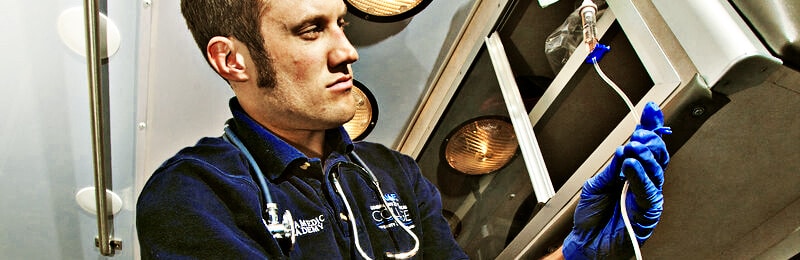
Your education
The Associate of Applied Science (A.A.S.) degree in paramedicine is a degree completion program that combines prerequisite paramedic academy and general education coursework with coursework completed through UAF CTC’s Paramedic Academy.
In your first year of study, you will complete prerequisite paramedic academy coursework that includes EMT basic certification and human anatomy and physiology, in addition to general education coursework in communications, mathematics, and human relations.
Once prerequisite academy coursework is complete, you will be eligible to apply to the Paramedic Academy where you will complete remaining degree requirement through paramedic academy coursework.
The Occupational Endorsement in Advanced Emergency Medical Technician (AEMT) is designed to prepare you to provide basic and limited advanced emergency medical care and transportation for critical and emergent patients who access the emergency medical system. The program includes both EMT-Basic and Advanced EMT coursework that will prepare you for both national and State of Alaska basic and advanced EMT certification.
Upon completion of the program you will learn how to function as part of a comprehensive EMS response, under medical oversight and develop the knowledge and skills required to provide patient care and transportation using the basic and advanced equipment typically found on an ambulance.
The program can be used as a stepping stone to the paramedicine associate degree for students interested in continuing to advance their knowledge through additional education.
The Paramedic Academy is an intensive three-semester program designed to prepare you for work in emergency medical services as a paramedic. The program will prepare you to take the National Registry Paramedic Exam. A passing score qualifies students to apply for a paramedic license through the Alaska State Medical Board.
The program provides the highest level of education available to prepare you for work in the pre-hospital environment. You will complete a minimum of 500 hours of classroom education, 480 hours of field internship and 232 hours of clinical experience.
First-semester coursework will focus on advanced emergency medicine, respiratory, cardiac, and nervous systems. The second semester will focus on medical emergencies, pediatrics, geriatrics, and trauma. The first and second semester will also include clinical rotations in clinical settings where you will observe and participate in patient care activities under the supervision of a preceptor. You will spend your final semester in hospitals and EMS service locations outside of Alaska.
Following the successful completion of all coursework, you will be eligible to take the National Registry Examination for certification as a paramedic. Once nationally certified, you will be eligible to apply for licensure as a paramedic in the State of Alaska.
Provided all A.A.S. requirements have been met, you will also be eligible for graduation with an associate degree in paramedicine.
The minor in arctic skills is designed for anyone who lives and works in a northern climate and wishes to learn to cope with the outdoor Arctic environment. Students who complete this minor also earn a State of Alaska EMT I certificate and may prepare to take the FAA written exam for partial fulfillment of the private pilot certificate requirements.
This minor is a great choice for Bachelor of Arts degree-seeking students who need to satisfy their minor requirement or Associate of Arts students who want to explore arctic skills as an area of interest.
Your career
Following successful completion of the program’s required course work, students are eligible to take the National Registry Examination for certification as a paramedic. Once nationally certified, you will be eligible to apply for licensure as a paramedic in the state of Alaska. Paramedic entry level positions may include ambulance response within a 911 emergency response system, in a non-emergency and transport system or in doctors’ offices, urgent care clinics, hospital emergency rooms, intensive care units, laboratories, aero medical transport services, and safety departments in corporate or industrial settings.
Program delivery
Delivery:
Program is completed through in-person courses in which students receive both classroom and practical hands-on learning experiences.
As part of the Paramedic Academy program, students will receive 500 hours of classroom instruction and complete 232 hours of clinical experience. The clinical lab component includes rotations in a hospital setting and placements in the emergency room, respiratory therapy, operating room, and intensive care unit. At the end of the program, students will travel outside of Alaska to complete a 480-hour field internship on an ambulance supervised by paramedic preceptors for a total of 1,212 hours (minimum) of training.
Paramedic Academy: The academy program is a cohort based program that accepts up to 20 students per cohort. Each student cohort progresses through a pre-determined sequence of courses each semester.
Scheduling:
Advanced EMT OE: EMT-Basic courses are offered both fall and spring semesters. The Advanced EMT course is offered in the spring semester.
Paramedic Academy courses are scheduled to meet daily throughout the fall and spring semesters. Students will travel to their externship site in the lower-48 in their final semester.
When to Start:
Paramedic Academy: The academy is offered once per year and begins in the fall semester. It is important for students to work closely with their program advisor to develop a plan to complete prerequisite coursework prior to applying to the Academy.
Location:
Program highlights
| Year | National registry written exam overall pass rate | National registry psychomotor exam overall pass rate | Retention rate (began academy vs. academy completion) | Job placement (EMS career or continued education) |
|---|---|---|---|---|
| 2023 | 100% | N/A | 80% | 100% |
| 2022 | 93% | 100% | 70% | 100% |
| 2021 | 100% | 91% | 85% | 91% |
| 2020 | 100% | 100% | 71% | 84% |
ACCREDITATION: The UAF CTC Paramedicine Program is accredited by the Commission on Accreditation of Allied Health Education Programs (www.caahep.org) upon the recommendation of the Committee on Accreditation of Educational Programs for the Emergency Medical Services Professions (CoAEMSP).
Commission on Accreditation of
Allied Health Education Programs
25400 US Highway 19 N., Suite 158
Clearwater, FL 33763
727-210-2350
www.caahep.org
To contact CoAEMSP:
8301 Lakeview Parkway
Suite 111-312
Rowlett, TX 75088
214-703-8445
FAX 214-703-8992
www.coaemsp.org
CAAHEP minimum expected program goal: “To prepare Paramedics who are competent in the cognitive (knowledge), psychomotor (skills), and affective (behavior) learning domains to enter the profession.”
Other details
APPLY TO THE PARAMEDIC ACADEMY: Admission into the Paramedic Academy is competitive. Applicants must meet the following eligibility requirements before applying to the Paramedic Academy:
- Be at least 18 years of age
- Be certified as a Nationally Registered EMT-B or State of Alaska EMT–I, II, or III.
- Earn a grade of ‘C’ or better in Fundamentals of Anatomy and Physiology (HLTH F114 or a combination of BIOL F111x and F112x).
Preference will be given to students who have also completed A.A.S. general education requirements, but the courses are not required before submitting an application to the program.
PARAMEDIC ACADEMY PREREQUISITES: Before applying to the Paramedic Academy program, students must complete prerequisite coursework with a grade of ‘C’ or better and attain National Registry or State of Alaska EMT certification. Students interested in applying to the Paramedic Academy program are encouraged to apply to the paramedicine A.A.S. degree and complete both general education and academy prerequisite coursework. While the general education and paramedic prerequisite coursework prepares students to be highly qualified, it does not guarantee admission to the program.
PARAMEDICINE A.A.S. PRE-MAJOR: When students apply to the paramedicine A.A.S. degree, they will be accepted into a pre-major status. They will be fully admitted into the A.A.S. degree once all paramedic academy prerequisites have been completed and they’ve been accepted into the Paramedic Academy. It is important for students to meet with a program advisor to develop a plan to move from pre-major status to being fully admitted into the A.A.S. degree program. Being admitted as a pre-major will not affect a student’s eligibility to receive financial aid.
PARAMEDIC ACADEMY EXPENSES: In the third semester of the Paramedic Academy the student will complete a field internship outside Alaska with an ambulance company supervised by paramedic field preceptors. During the internship, the student is responsible for all costs of housing, travel and living expenses in addition to tuition and fees.
PARAMEDICINE REQUIRED SKILLS & ABILITIES: The paramedic student should be emotionally stable and have good dexterity, agility and physical coordination. Paramedics must also have the strength to lift and carry heavy loads. Use the following links to download and view a comprehensive description of expected skills and abilities of paramedic students and the National Highway Traffic Safety Administration’s functional job analysis for a paramedic.
Contact Us
Have questions? Would you like more information? Let us help connect you to an expert who can answer your questions and/or help you with pre-admission, academic assessment, financial aid or choosing a major.
Get connected to an expert