


Third 2026 mission launches from Poker Flat Research Range
Rod Boyce
907-474-7185
Feb. 10, 2026
A tandem of NASA sounding rockets blasted off from Poker Flat Research Range at about 1:30 a.m. today on a mission to better understand how changes in the ionosphere influence the aurora’s appearance.
Two rockets were launched 30 seconds apart to gather information from different points. The experiment is led by Dartmouth College physics and astronomy professor Kristina Lynch.
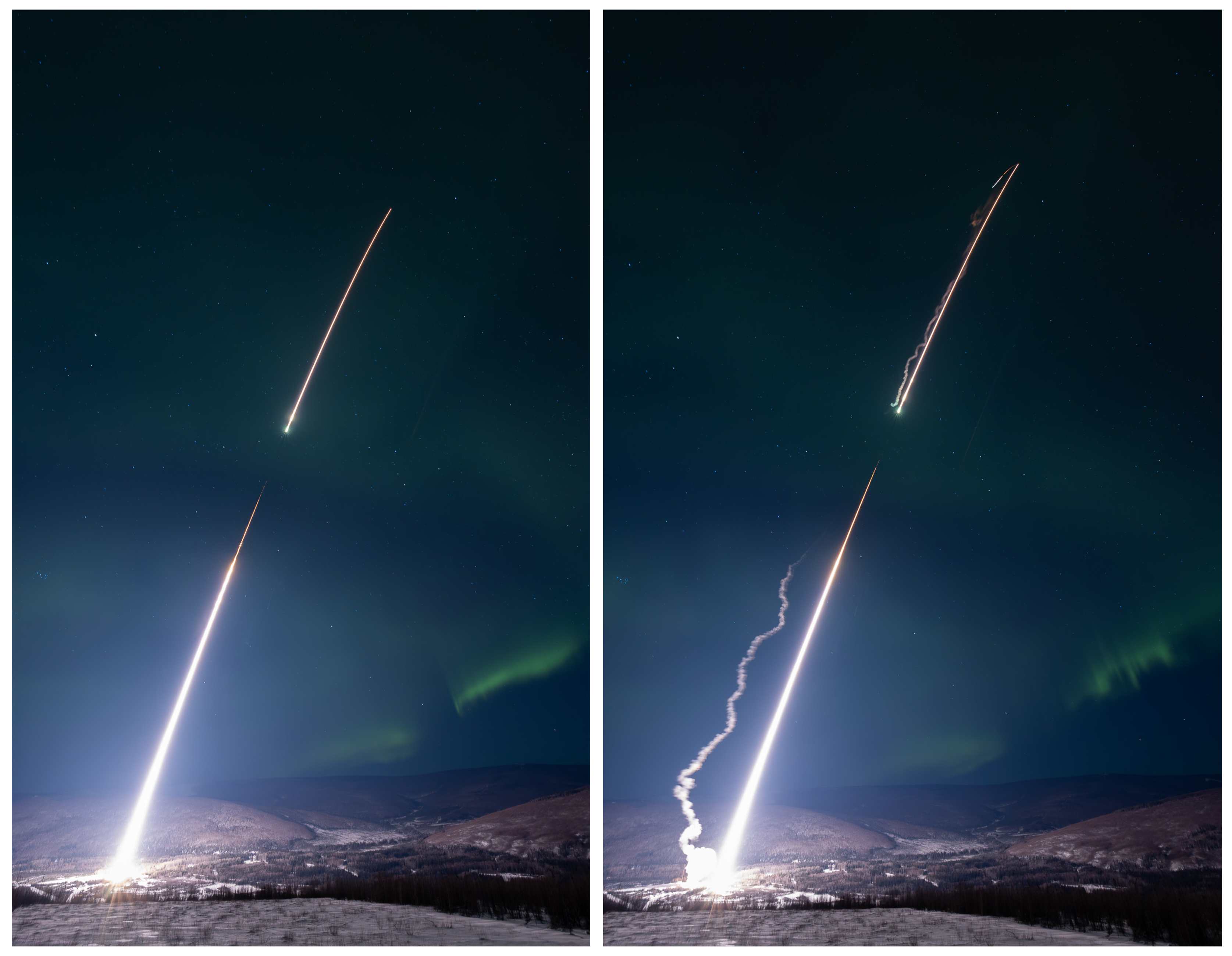
Two NASA sounding rockets launched 30 seconds apart from Poker Flat Research Range early Feb. 10, 2026. The rockets carried instruments for a mission to learn how the ionosphere influences some visible features of the aurora.
The launches marked the third successful mission and fourth rocket launched for Poker Flat in 12 days, a much tighter schedule than in previous years.
The University of Alaska Fairbanks Geophysical Institute owns Poker Flat, located at Mile 30 Steese Highway, and operates it under a contract with Wallops Flight Facility, which is part of NASA’s Goddard Space Flight Center.
The Geophysical Non-Equilibrium Ionospheric System Science experiment that launched today studies how the upper atmosphere behaves when sudden bursts of energy, often linked to the aurora, disturb the ionosphere and push it out of its usual balance.
The aurora is the visible indicator of the plasma physics that GNEISS is measuring.
Each rocket carried a main payload of instruments to collect data about the ionosphere’s electric, magnetic and particle environment. They each also carried four small sub-payloads that were ejected to gather data from other points in the trajectory. Ground stations at several sites across central and northern Alaska photographed the experiment.
The rockets also carried beacons that relayed additional signals to 11 ground receivers built by Lynch’s students to determine the ionosphere’s density.
The first of this season’s three missions launched Jan. 30.
The Polar Night Nitric Oxide, or PolarNOx, mission sought to learn more about aurora-produced nitric oxide in the upper atmosphere. Nitric oxide, a gas, can travel to lower atmospheric levels, where it can damage Earth’s protective ozone layer.
That mission is led by engineering professor Scott Bailey of Virginia Tech and is part of a longer PolarNOx project. A 2020 launch occurred when auroral activity was less frequent due to the sun just coming out of the low point of its 11-year cycle.
The 2026 launch provided measurements during the cycle’s high point.
The second mission launched early Monday. The mission had run out of time during 2025’s launch window.
The Black and Diffuse Aurora Science Surveyor mission is led by Marilia Samara of Goddard Space Flight Center.
Black auroras form when streams of auroral particles temporarily create well-defined dark shapes that drift and evolve within the broader glow of a diffuse aurora. Diffuse auroras are typically faint and spread over large areas.
ADDITIONAL CONTACT: Sarah Frazier, NASA Goddard Space Flight Center, sarah.frazier@nasa.gov
158-26