


State, Cooperative Extension offer free grower safety course
Julie Stricker
907-474-5406
Dec. 10, 2025
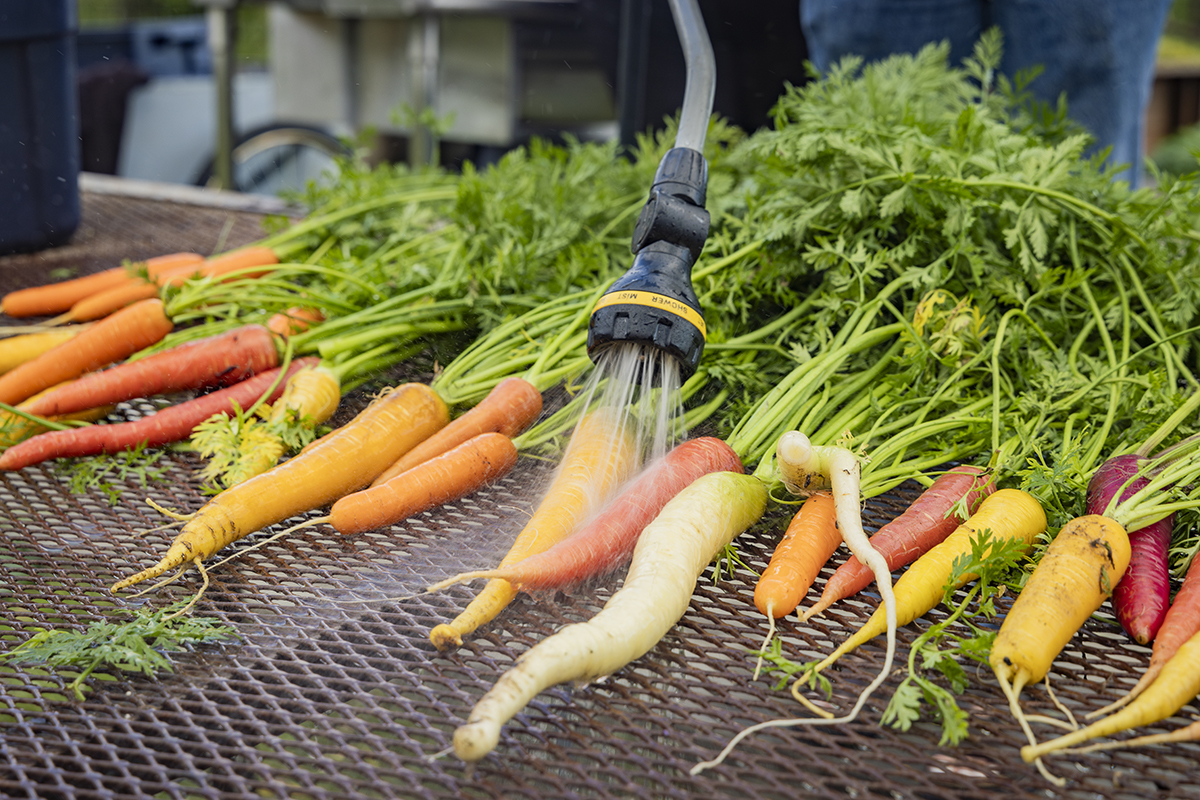
In a training class in January, farmers can learn about safely handling produce like these freshly harvested carrots from UAF’s Nanook Grown garden in 2024.
The Alaska Department of Environmental Conservation and the University of Alaska Fairbanks Cooperative Extension Service will hold a Produce Safety Alliance grower training in January.
The alliance is a collaboration between Cornell University, the Food and Drug Administration and the U.S. Department of Agriculture. The training satisfies the grower training requirements under the Food Safety Modernization Act. It is free and open to any grower interested in learning about safety.
Participants will learn about:
- Microorganisms relevant to product safety and where they may be found on a farm
- How to identify microbial risks, use practices that reduce risks and implement food safety practices on a farm
- The requirements of the FSMA produce safety rules and how to meet them
Growers who attend all seven training modules will receive a certificate of course completion.
The training is Jan. 21-22 from 9 a.m.-3:30 p.m. each day via Zoom.
Space will be limited, so preregistration is required. Registration closes Jan. 6.
Email producesafety@alaska.gov for more information and to register.
Participants must have a computer or mobile device with audio and video capabilities, as well as access to a strong internet connection and adequate bandwidth. Attendees who wish to receive a certificate will be required to use the web camera to ensure participation.
ADDITIONAL INFORMATION — Accommodation requests related to a disability should be made five business days in advance to Alda Norris at amnorris2@alaska.edu or 907-474-7120. Language access services, such as interpretation or translation of vital information, will be provided free of charge to individuals with limited English proficiency upon request to amnorris2@alaska.edu.
This work is supported by the U.S. Department of Agriculture's National Institute of Food and Agriculture.
121-26