


Research offers defense against energized space electrons
Rod Boyce
907-474-7185
Dec. 9, 2025
Research at the University of Alaska Fairbanks Geophysical Institute is advancing the ability to quickly clean up Earth’s radiation belts from a flood of energetic electrons created by an extraordinary solar blast or a nuclear explosion in space.
Many of these incoming electrons become trapped in the Earth’s outer radiation belt and can damage or destroy satellites and other spacecraft by penetrating their electronics.
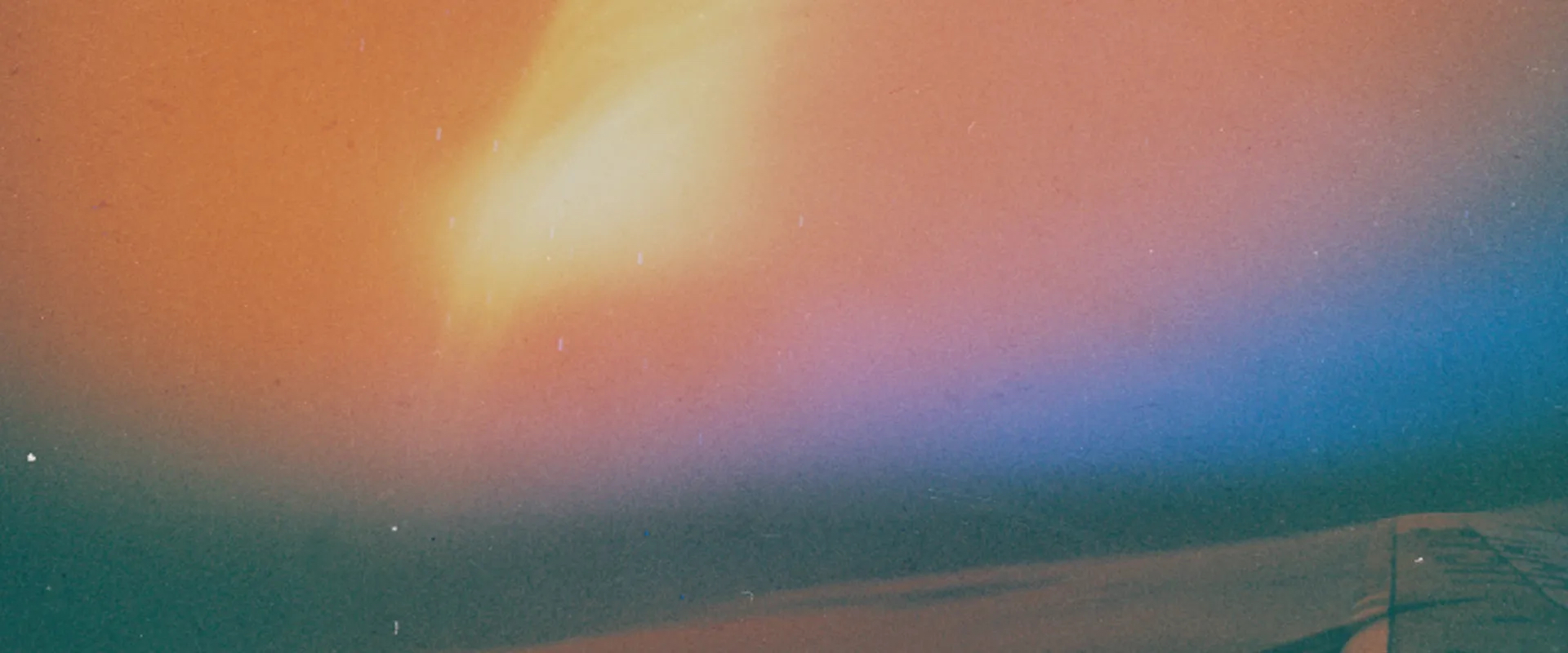
In this photo taken from an aircraft, the atmosphere glows after the United States detonated a nuclear device 250 miles above the Pacific Ocean on July 9, 1962. The Starfish Prime explosion intensified Earth’s radiation belts and generated an electromagnetic pulse that darkened streetlights on the island of Oahu, 800 miles away.
Natural loss of those “killer” electrons, as they are sometimes called, can take weeks or months.
Geophysical Institute research professor Paul Bernhardt has devised and tested a method that could lead to a way to clean up the radiation belt in just a few minutes, depending on the electrons’ energy level.
Bernhardt and UAF graduate student researcher Sam McKay have been presenting the method at science conferences. Bernhardt will present it again at the American Geophysical Union’s annual meeting later this month. That meeting attracts about 20,000 people annually.
“It is important to have a reliable way of removing unwanted electrons from the radiation belt to keep satellites working longer after a sudden increase in radiation belt particles,” Bernhardt said.
Bernhardt’s idea is to knock the electrons out of the radiation belt through a space-based amplification of a special type of electromagnetic wave originating at a ground station.
The wave amplification would occur in a remarkable way: by use of a passing rocket’s engine exhaust.
Why it matters
Navigation satellites in medium Earth orbit and communication or weather satellites in geostationary orbit operate in the outer radiation belt, as do scientific spacecraft. About 12,000 active satellites are in orbit.
The outer radiation belt is also where these energized electrons reside. They can circle Earth in a few minutes to about an hour, depending on their energy level.
Satellites and spacecraft are designed with shielding and electronics to tolerate levels that have become known to scientists.
A surge of electrons from strong solar activity, however, creates even more of these energized particles. So would a nuclear detonation in space.
A July 1962 nuclear test by the United States about 250 miles above the Pacific Ocean intensified Earth’s radiation belts, created a vivid aurora, knocked out several satellites and generated an electromagnetic pulse that disrupted power and communications as far away as Hawaii.
The explosion was one of several high-altitude nuclear blasts by the U.S. and the Soviet Union from 1958-1962. Those detonations spawned research into cleaning up the aftermath.
Attention eventually turned to ground-based transmission of very low frequency waves, which became and remains the dominant area of research.
In the U.S., radiation belt cleanup research is underway through the Air Force Research Laboratory, Los Alamos National Laboratory and universities. A 2023 rocket launch at Poker Flat Research Range north of Fairbanks carried a Los Alamos radiation belt cleanup experiment using a method different from Bernhardt’s.
Bernhardt’s work was funded by the National Science Foundation. Co-authors received funding from NASA and other sources.
The science
Bernhardt’s continuing work is called rocket exhaust-driven amplification.
The process starts with the ground transmission of very low frequency waves into the ionosphere. The ionosphere, which begins at about 30 miles altitude, is a plasma shell where solar radiation strips electrons from atoms and fills the upper atmosphere with charged particles.
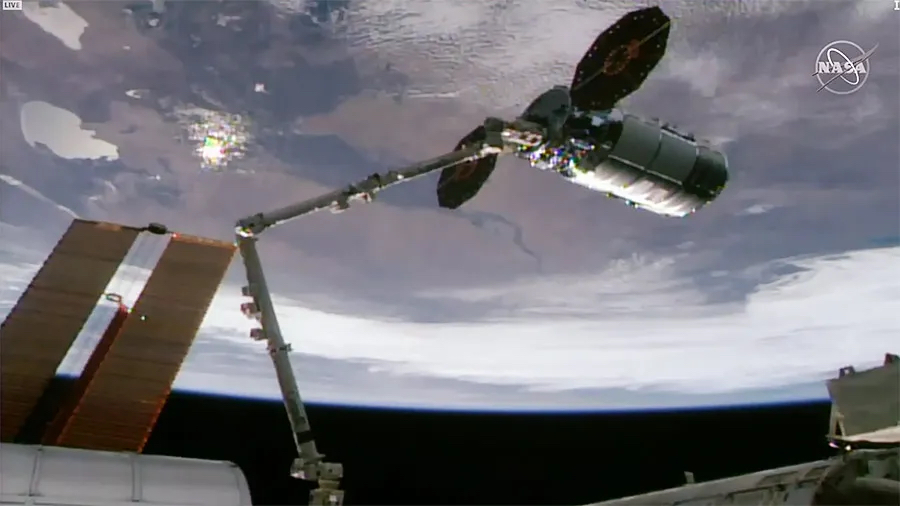
This U.S. Cygnus uncrewed cargo craft was about 12 meters from the International Space Station station when the robotic arm captured it in February 2020. The cargo spacecraft provided the engine burn used in Paul Bernhardt’s experiment.
The waves stretch and change shape when they reach the ionosphere. The result is a wave called a “whistler.” (Listen to a whistler wave.)
That wave isn’t strong enough at that point to knock out the energized electrons, so Bernhardt’s method gives it a boost with the help of rocket exhaust from a passing satellite or other spacecraft.
The interaction of rocket exhaust molecules and the ionosphere’s oxygen ions creates a localized corridor through the Earth’s magnetic field. The corridor, composed of enhanced plasma, guides the whistlers in and out of the radiation belt.
Think of it as an invisible net of waves in the magnetic field at a fixed longitude, running hemisphere to hemisphere. High-energy electrons rapidly circling the planet pass through the net several times, getting a slight nudge each time until they fall into the atmosphere or are scattered further into space.
More work ahead
A first test of Bernhardt’s rocket-exhaust idea involved transmission of very low frequency waves from a Navy submarine communications site in North Dakota.
That test was only of the exhaust-driven amplification. How it affected the radiation belt was left to modeling because the test didn’t occur during an electron influx.
Bernhardt said he is trying to schedule more experiments using both current and dedicated rocket burns.
“Our world has become so reliant on electronics for social interaction, commerce and national security that it’s important we have the ability to quickly respond to radiation belt disruptions,” he said.
ADDITIONAL CONTACT: Paul Bernhardt, pabernhardt@alaska.edu
NOTE TO EDITORS: Results of the test of Bernhardt's method are available in a paper published in JGR Space Physics.
119-26