


Registration opens for 2026 Alaska Invasive Species Workshop
Krista West
907-474-5406
Oct. 13, 2026
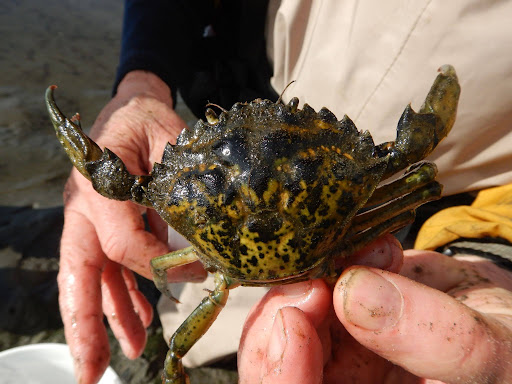
The European green crab — displayed here as part of an invasive species identification campaign in Washington state — is spreading northward along the Southeast Alaska coast and will be a major topic of discussion at the 2026 Alaska Invasive Species Workshop. The invasive European green crab competes with Dungeness crab and harms eelgrass beds in Alaska.
The 2026 Alaska Invasive Species Workshop, a forum for land and invasive species managers and scientists to discuss current issues, will be held October 27-29, 2026, in Juneau.
The University of Alaska Fairbanks Cooperative Extension Service is coordinating the workshop with the Alaska Invasive Species Partnership, an informal statewide group of agencies, organizations and individuals concerned about invasive species.
This year’s theme is “The Power of Proactive Conservation: Eyes on the Horizon, Solutions on the Ground.” Presenters will highlight invasive species science, management and planning, while identifying emerging issues statewide. Topics include managing invasive species in a changing climate, invasive species ecology and research, early detection and rapid response efforts, native plant production, the European green crab, harvest incentives and more.
In addition to studying and managing invasive species currently found in Alaska, AKISP partners work to prevent the introduction of new invasive species. For example, the partners are tracking, inspecting and decontaminating recreational watercraft transported to Alaska from regions with known populations of zebra and quagga mussels. They’re also seeking to contain the spread and mitigate the impacts of the European green crab in Southeast Alaska and signal crayfish on Kodiak Island.
The first keynote speaker, Catherine de Rivera, is a professor in the Department of Environmental Sciences and Management at Portland State University, where her research focuses on invasive species and habitat connectivity. Her presentations address the European green crab invasions in Southeast Alaska and incentivizing community harvest of invasive species as a management tool. The second keynote speaker, Kate Wyman-Grothem, is a fish biologist with the U.S. Fish and Wildlife Service and will address making practical applications out of invasive species risk assessments.
Sessions will run from 8 a.m. to 4:30 p.m. each day. For those unable to attend in person at the Centennial Hall Convention Center in Juneau, a virtual option is offered. The in-person cost is $180, and registration for the virtual option is $60. Zoom links will be available in October.
The workshop agenda and registration information are available at alaskainvasives.org.
For more information, contact the event coordinator Gino Graziano, at 907-786-6315 or gagraziano@alaska.edu.
ADDITIONAL INFORMATION: Accommodation requests related to a disability should be made five business days in advance to uaf-ianre@alaska.edu or 907-474-5211. Language access services, such as interpretation or translation of vital information, will be provided free of charge to individuals with limited English proficiency upon request to uaf-ianre@alaska.edu.
This work is supported by the U.S. Department of Agriculture’s National Institute of Food and Agriculture.
057-27