


Three missions, four rockets: Poker Flat ready for launches
Rod Boyce
907-474-7185
Jan. 27, 2026
The 2026 Poker Flat Research Range launch season opens this week with the first of three missions studying the aurora and the upper atmosphere.
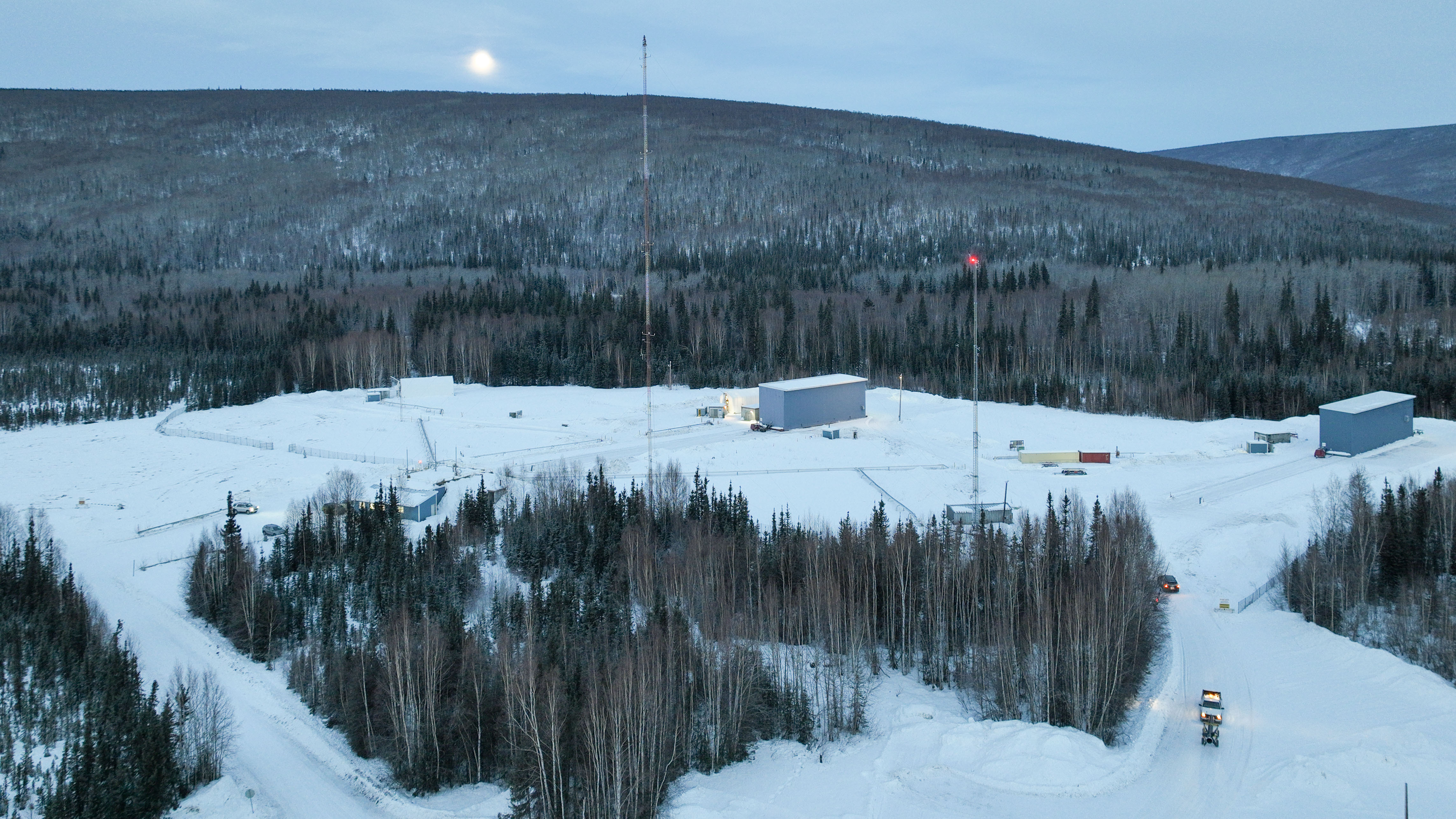
Retractable coverings — the blue rectangular structures — cover two of the four launchpads at Poker Flat Research Range north of Fairbanks.
The first mission, PolarNOx, will have its initial launch opportunity at 4:20 a.m. Friday morning. Crews will arrive late Thursday at Poker Flat, which is owned by the University of Alaska Fairbanks Geophysical Institute.
The two other missions, one of which includes two rockets launched simultaneously, have their first launch opportunities Feb. 7.
“It’s an exciting time for Poker Flat as we prepare for several NASA missions,” said Kyle McAllen, Poker Flat’s range director. “These launches will further our understanding of how the sun interacts with the Earth’s magnetosphere and the physics driving the aurora.”
Each mission will use a two-stage NASA BlackBrant IX rocket, which stands about 46 feet tall and can reach heights of more than 200 miles. The unguided rockets and any jettisoned payloads fall back to Earth in the authorized flight zone north of Fairbanks and will be recovered.
Text PFRRLAUNCHES to 866-485-7614 to subscribe to launch updates. Go to the Poker Flat active missions webpage to view live broadcasts.
UAF operates Poker Flat, located at Mile 30 Steese Highway, under a contract with NASA’s Wallops Flight Facility, part of Goddard Space Flight Center.
PolarNOx
Engineering professor Scott Bailey of Virginia Tech and his team will be at Poker Flat for a mission to help quantify the amount of aurora-produced nitric oxide in the upper atmosphere.
Nitric oxide, NOx, can in some conditions migrate to lower atmospheric levels, where it can harm Earth’s protective ozone layer.
The rocket will carry the Polar Night Nitric Oxide, or PolarNOx, instruments to an altitude free of nitric oxide to get a clear view of the star Algenib. As the rocket ascends and descends, an ultraviolet instrument aboard the rocket will look for tiny losses in the starlight caused by nitric oxide. Those changes will allow Bailey to map how the gas is distributed at different heights.
The aurora creates nitric oxide from nitrogen, an almost inert gas.
“It has such a strong bond that it can’t participate in many chemical reactions,” Bailey said. “But the huge amount of energy from the aurora does break it apart, and then you get simple nitrogen atoms. And when that atomic nitrogen reacts with molecular oxygen, we get nitric oxide.”
This is the second PolarNOx mission. The first launched in 2020, when auroral activity was less frequent due to the sun just coming out of the low point of its 11-year cycle. Now Bailey is getting measurements at solar maximum.
“There were very small amounts of aurora, yet we measured amounts of nitric oxide that were almost unprecedented,” he said. “So if a little aurora still leaves us with a lot of nitric oxide, what happens when you get a lot of aurora?”
GNEISS
The Geophysical Non-Equilibrium Ionospheric System Science, or GNEISS, consists of two rockets that will launch 30 seconds apart to cross an arc together. Its launch window is Feb. 7-20.
The mission aims to gather information about how disturbances in Earth’s middle and upper ionosphere distort auroral sheets, those that look like smooth curtains or bands. The distortions can appear as variations and bends or folds along the length of an auroral curtain.
“We want to learn what the visible signatures tell us about the underlying processes,” said Dartmouth College physics and astronomy professor Kristina Lynch, the mission’s lead investigator. “We want to know how electric currents in the nightside aurora thread and control the auroral system.”
Each rocket will carry a main payload holding instruments to gather data about the ionosphere’s electric, magnetic and particle environment. Each main payload will also carry four small sub-payloads, about the size of a coffee can, that will be ejected to gather data from other points in the trajectory.
Those data will be compared with optical data from ground cameras staffed at several sites across central and northern Alaska.
The rockets will also carry beacons that will relay additional signals to 11 ground receivers built by Lynch’s students. Those data will be used to determine the ionosphere’s density.
Lynch is a longtime aurora researcher who has been associated with numerous Poker Flat launches since 1988.
BaDASS
The Black and Diffuse Aurora Science Surveyor mission is led by Marilia Samara of NASA’s Goddard Space Flight Center. The project focuses on understanding the origin of a little-understood auroral form known as black aurora.
Its launch window is Feb. 7-20.
The mission was on the launchpad at Poker Flat in early 2025, but the necessary aurora conditions didn’t materialize before the launch window closed.
“We cooperated with nature as best we could, but sometimes the conditions nature sets are just not the conditions that would produce the outcome a scientist might want,” Samara said at the time. “That's life as a scientist.”
Black auroras form when streams of auroral particles temporarily thin or shut off in small regions of the upper atmosphere, creating well-defined dark shapes within the broader glow of a diffuse aurora. Diffuse auroras themselves are typically faint and spread over large areas, making them difficult to see without dark skies and frequent auroral activity.
To the human eye, black auroras look as though pieces of the aurora have been erased. These dark structures drift and evolve along with the surrounding aurora, sometimes appearing to slide through the glowing background like moving gaps in the sky.
ADDITIONAL CONTACT: Sarah Frazier, NASA Goddard Space Flight Center, sarah.frazier@nasa.gov
147-26