


Makerspace brings device from lab to market
Kate Avery
9074745414
Apr. 24, 2026
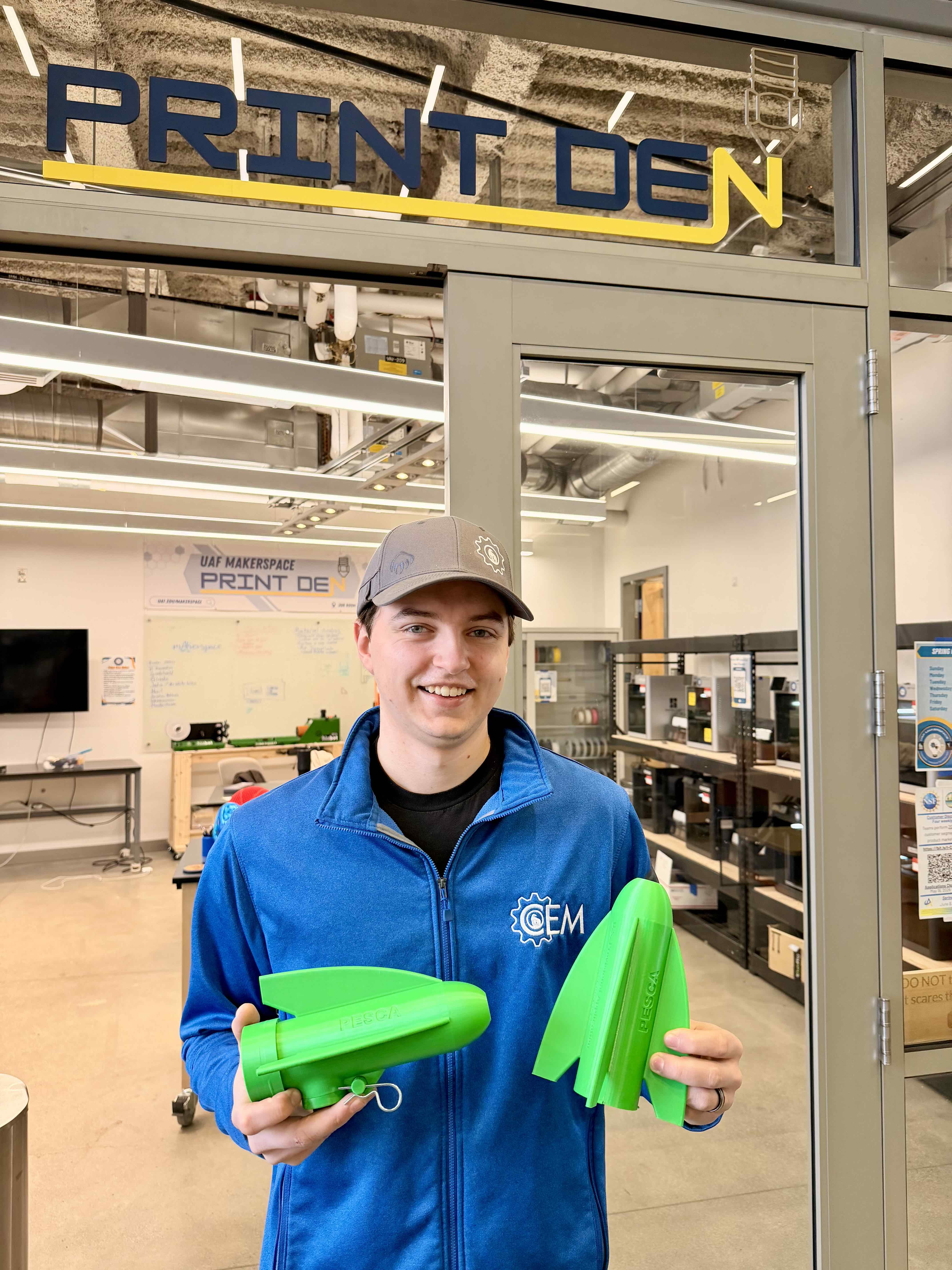
Tate Barhaug, Lab Manager of the UAF Makerspace Print Den, holds 3D-printed prototype components produced in the lab.
At the College of Engineering and Mines, innovation doesn’t stop in the lab. It moves into the hands of researchers, communities and now into the marketplace. The CEM Makerspace is helping bring new tools to market with PESCA (Passive eDNA and Sediment Collection Apparatus), a device designed to make environmental sampling more accessible, efficient and scalable.
Developed to support field research, PESCA allows users to collect environmental DNA and sediment samples without active pumping or complex equipment. That simplicity matters. In Alaska, where field conditions are often remote and unpredictable, tools need to be reliable, portable, and easy to deploy.
The Makerspace partnered with the College of Fisheries and Ocean Sciences to help turn Assistant Professor Jessica Glass’s concept into a physical product. Through rapid prototyping, iterative design and small-scale manufacturing, the team helped refine PESCA into something that could move beyond research use and into broader distribution. Now, the device is available for purchase, marking a shift from internal innovation to external impact. You can find PESCA in the UAF Makerspace Store.
This step reflects a larger trend at CEM, where research doesn’t just generate knowledge, but produces tools others can use. By supporting patent-ready designs and small-batch production, the Makerspace is helping bridge the gap between idea and application.
For researchers, agencies and organizations working in environmental monitoring, PESCA offers a practical solution grounded in field-based needs. For CEM, it’s another example of how engineering and science can translate into tangible outcomes.