


Drone research gets a lift from UAF ice tower
Rod Boyce
907-474-7185
Sept. 30, 2026
Traveling through any of Alaska’s major airports in winter usually means taking a shower.
An aircraft de-icing shower.
Ice buildup on wings reduces lift, a dangerous occurrence for airplanes, helicopters — and drones.
The ice tower of the Alaska Center for Unmanned Aircraft Systems Integration, ACUASI, at the University of Alaska Fairbanks Geophysical Institute is where research into wintertime drone flight happens.
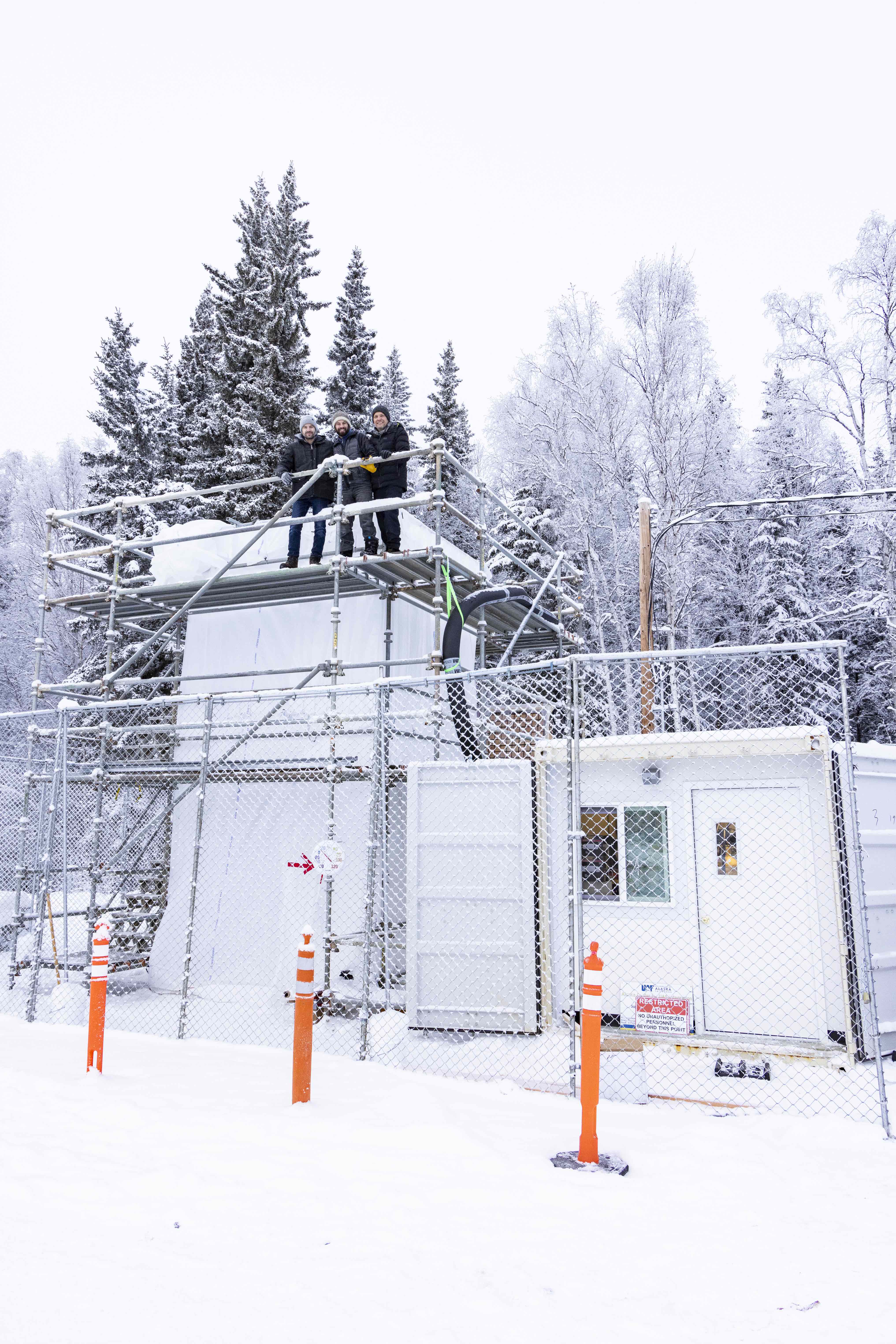
From left, Coda Consulting CEO Mathieu Gibeault, Eyal Saiet of ACUASI, and Gislain Chevrette, also of Coda, stand atop the new icing tower at the University of Alaska Fairbanks in February 2025. Coda Consulting of Ottawa, Canada, built the tower.
The tower, formally called the Supercooled Water Experimental Arctic Tower, or SWEAT, is integral not only for research into the conditions that drones can encounter but also for the training of the next generation of drone designers and operators through the UAF College of Engineering and Mines. It opened in early 2025.
“We are integrating academics, research and operations so that the students are working in all three of those domains,” associate professor Mike Hatfield said. “And with ACUASI, it’s pretty natural.”
Hatfield is an electrical and computer engineering instructor at the College of Engineering and Mines. He is also ACUASI’s associate director for education.
Hatfield is the leading force behind creation of UAF’s aerospace engineering
degree program. The program, entering its fourth academic year, offers students four tracks to choose from: aeronautics, unmanned aircraft systems, space systems and astrodynamics, and — new in 2026 — robotics.
ACUASI’s ice tower provides a unique research opportunity for students in the aeronautics and unmanned aircraft systems tracks.
“The ice tower supports aircraft icing, which happens to be an interesting aspect of drone operations,” Hatfield said. “We have to consider icing up here in the Arctic.
“We’ve got a lot of drone operations, and we’re looking to do advanced air cargo flights,” he said.
Eyal Saiet, ACUASI’s lead ice tower researcher, said the drone program and aerospace engineering degree both benefit from the ice tower.
“It’s a good focal point between the aerospace degree program and ACUASI,” Saiet said. “We aim to improve drone flight resilience in Arctic conditions through research and engineering.”
“Batteries failing in cold temperatures is a well-researched topic, but ice accretion on drones is another challenge that is difficult to test and encompasses drones, airplanes and helicopters,” he said. “Icing is a real problem.”
What is icing?
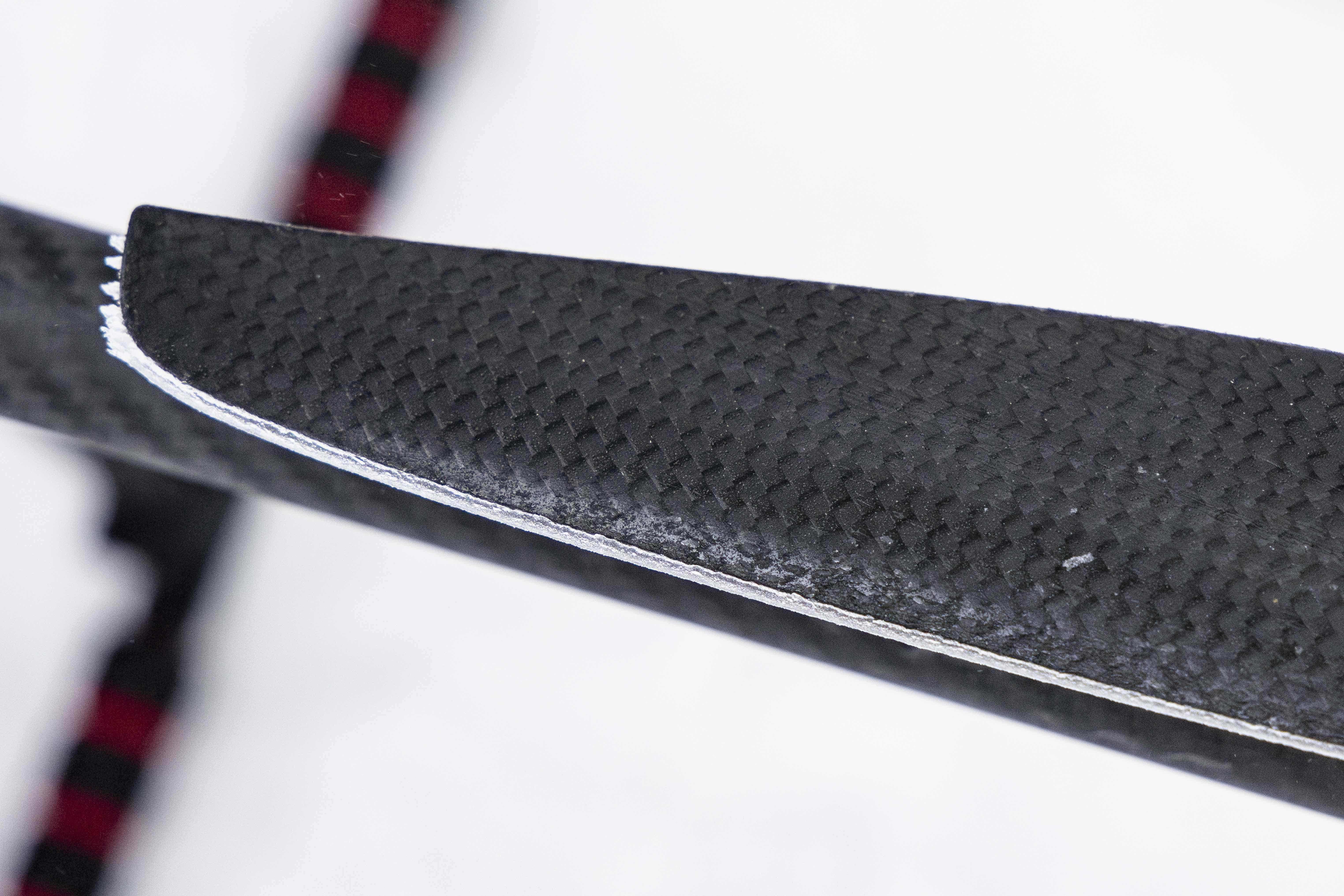
Ice builds up on a drone rotor blade.
Liquid water drops in the air that are colder than freezing can build up as ice on wings or rotor surfaces. The ice changes airflow, reducing lift and affecting aircraft control.
That can become a potentially catastrophic problem for drones and higher-flying crewed aircraft in clouds or while climbing through them to get above the icing conditions.
Drones can be especially vulnerable to icing because of their small size. Even a relatively small amount of ice can significantly affect their aerodynamic performance.
An airplane flying at 20,000 feet has much less risk of icing than a drone flying slowly and close to the ground. As the air is typically drier at high altitude, it’s much harder for liquid water to freeze on the aircraft without it being blown off.
FAA icing standards distinguish between smaller cloud droplets and larger supercooled droplets, such as those found in freezing drizzle and freezing rain.
Large drops pose a greater challenge because they freeze differently than smaller drops when they strike cold aircraft surfaces. They can shatter or spread on impact, allowing water to flow farther across the surface before freezing and causing ice to build up in areas that may be difficult or impossible to protect.
The tower
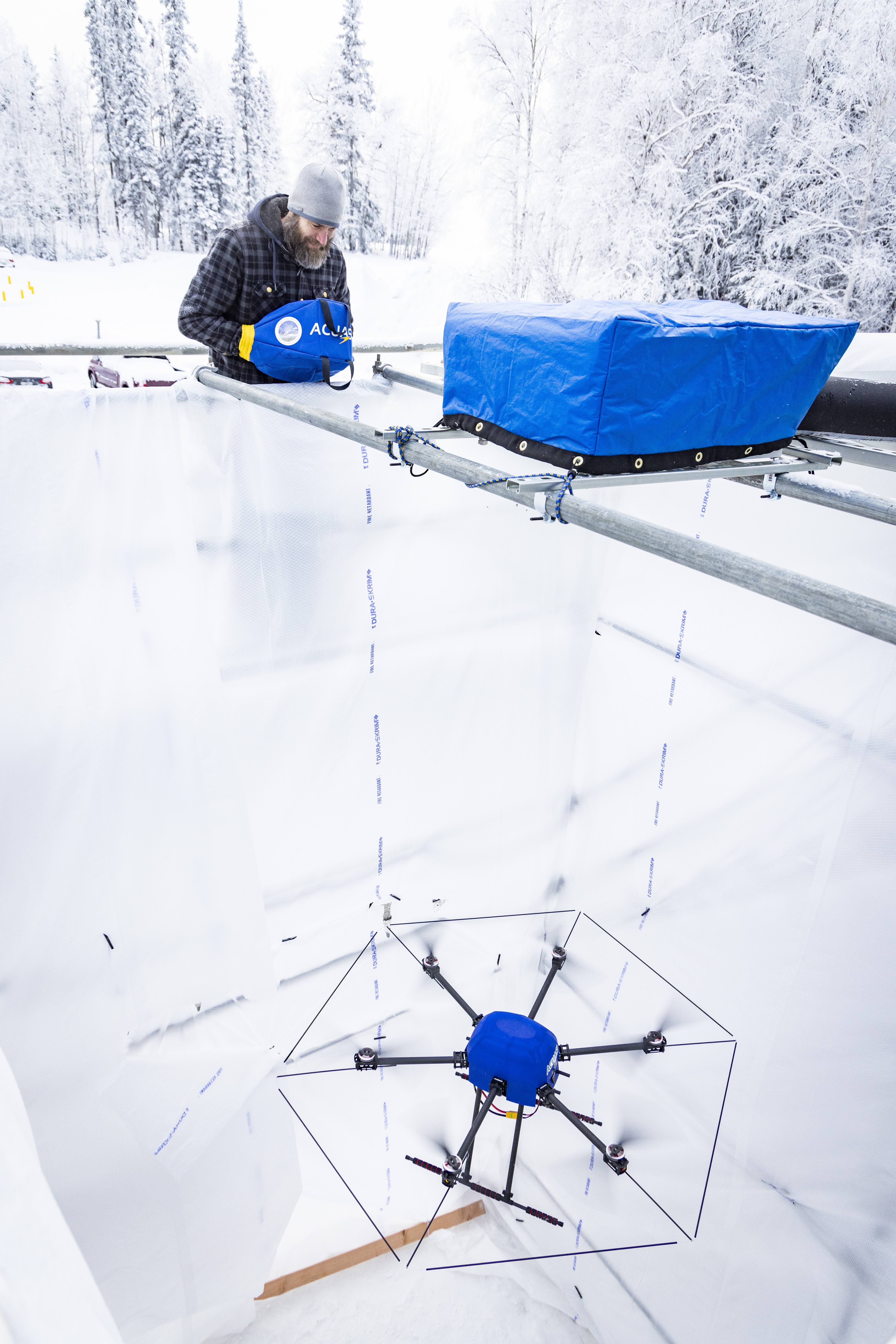
ACUASI pilot Matthew Westhoff flies a drone inside the University of Alaska Fairbanks icing tower in February 2025.
ACUASI’s ice tower is somewhat like a wind tunnel commonly used to test aircraft, except it’s smaller and vertical. It stands at about 16 feet and is located in a fenced area behind UAF’s Reichardt Building.
The tower can create various types of calibrated icing conditions, enabling drones to fly in a controlled environment simulating real-world scenarios. That makes it a critical asset for advancing drone safety and performance in harsh weather conditions.
Saiet led ACUASI’s effort to develop the tower and hopes to expand icing research, with the tower itself expanding to also serve fixed-wing drones. The site currently lacks a horizontal component for creating wind scenarios.
“I would like to see us become an aerospace icing complex,” he said.
Understanding how icing can affect a drone is critical as Alaska accelerates an effort to use unmanned aircraft for deliveries to remote communities and for emergency response in harsh weather conditions.
The tower has also caught the attention of the business community and research agencies.
“We have customers asking about it,” Saiet said. “A drone cargo company is investigating icing, because they want their drones to be able to deliver in icing conditions when the roads are bad and nobody wants to drive.”
“Drone shipping companies are aware of icing,” he said. “It’s a very tricky topic.”
A student’s story
Doctoral student Morakinyo Labiran is researching ways to inhibit ice buildup on fixed-wing and rotary drones.
The ice tower is essential for his work.
In 2025 he led a team using the tower to conduct stationary and flight tests to study laboratory-made coatings designed to prevent ice buildup. He analyzed their effect on ice freezing time and aerodynamic performance.
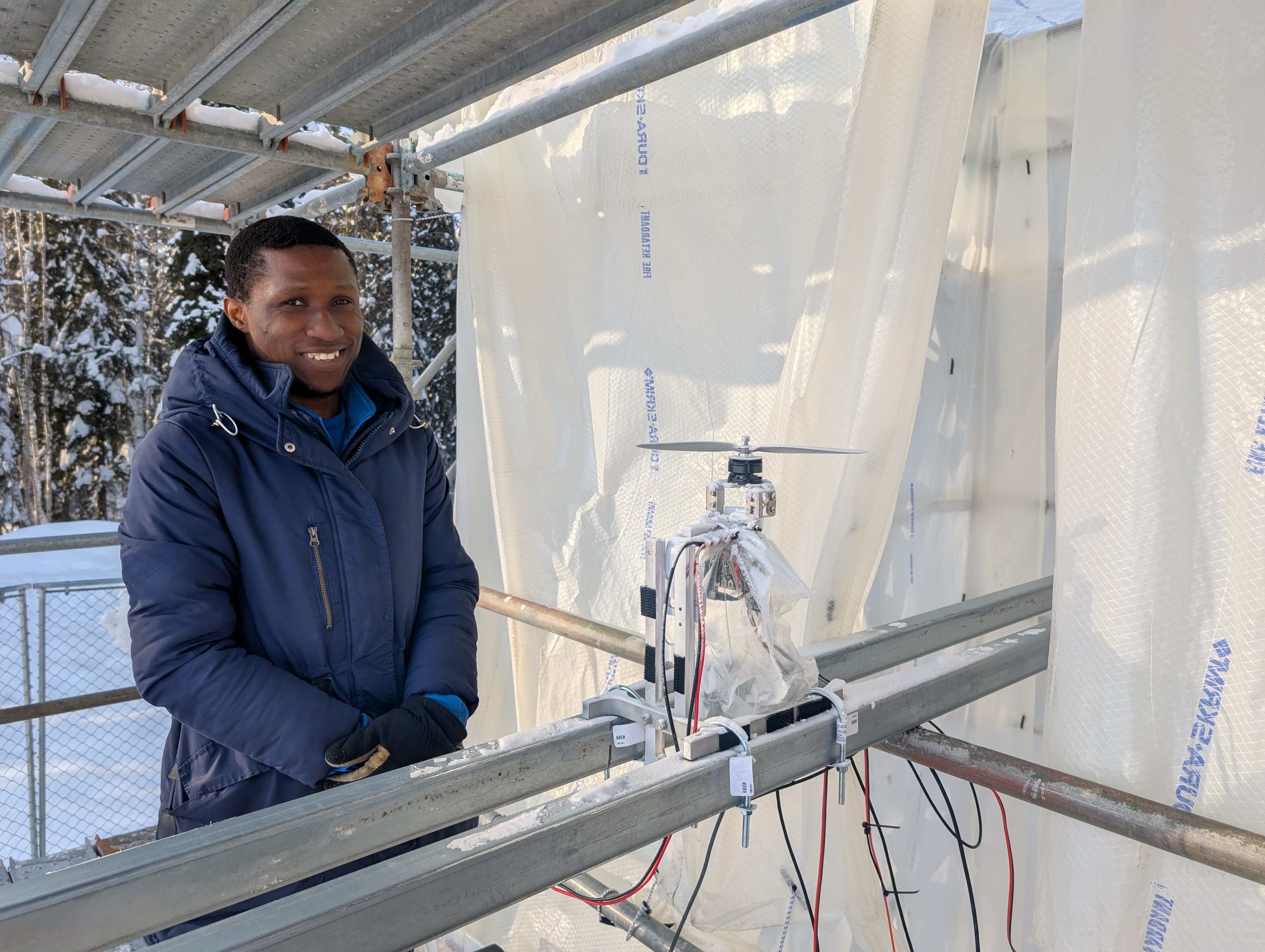
Doctoral student Morakinyo Labiran stands at ACUASI’s ice tower beside his planned test item.
“The ice tower enabled us to make several tests, providing enough data to measure the effectiveness of these solutions,” Labiran said. “The tower’s 16-foot height provides space for hovering and observing how its flight dynamics change in real time.”
Labiran said several studies have highlighted the need for a controlled space to investigate in-flight icing conditions.
“This has been a challenge to the maturity of icing solutions,” he said.
Labiran is Nigerian. He earned his bachelor’s in mechanical engineering from Federal University of Technology, Akure, and a master’s in mechanical engineering from the University of Ibadan, both in Nigeria.
What got Labiran interested in the subject? He credits his advisor, Miracle Oyewola, UAF associate professor of mechanical engineering.
“My first thought was that it would be easy – just find a means to heat up the surface,” Labiran said. “I soon found out that this was not the case.”
“It required more critical thinking due to the drone’s limited power capacity, its material properties and the complexity of the ice adhesion process,” he said.
The real-world impact inspires Labiran.
“It is deeply multidisciplinary,” he said, “but that’s exactly what makes it very interesting, as I love learning new things.”
ADDITIONAL CONTACTS: Mike Hatfield, mchatfield@alaska.edu; Eyal Saiet, ejsaiet@alaska.edu
051-27