


‘Alaska Voices’ shares climate adaptation stories
Lia Ferguson
907-474-1880
Dec. 3, 2025
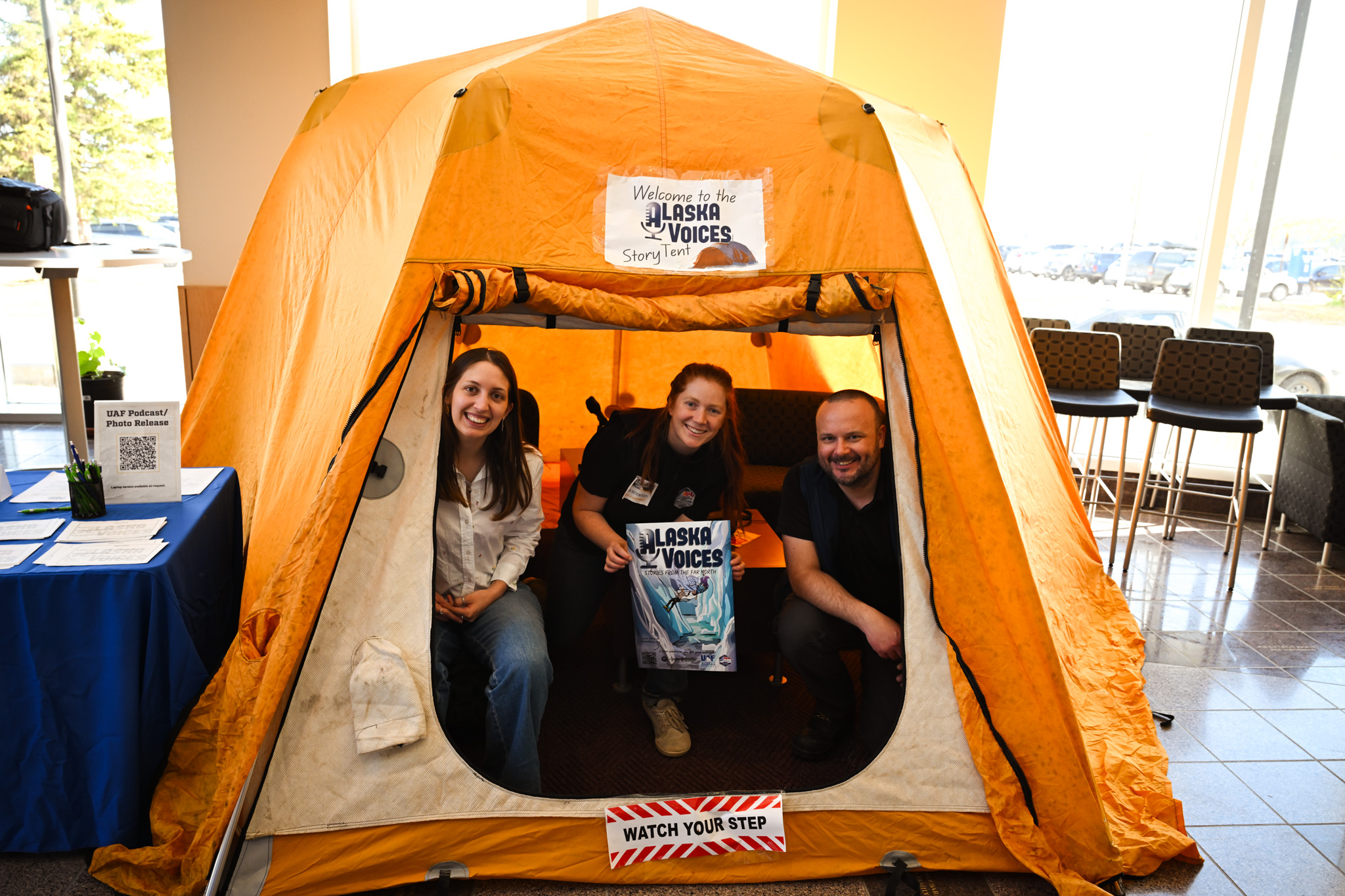
Elizabeth Carter, Lia Ferguson and Mike DeLue, members of the “Alaska Voices” team, pose inside the Arctic Oven Story Tent display at the University of Alaska Fairbanks 2025 Arctic Research Open House.
The second season of the podcast “Alaska Voices” launched on Dec. 1, bringing listeners into the lives of Alaskans dealing with one of the most rapidly changing environments on Earth.
In episode 1, scientists Chris Waigl and Nancy Fresco discuss how they were pulled into the world of climate science and how scientists can build trust and connections with the communities they serve.
Working with communities and individuals outside the university “makes the science better because you're talking with people who ask the really hard questions,” Waigl said.
“Alaska Voices” is funded by the Alaska Climate Adaptation Science Center, a partnership between the University of Alaska and the U.S. Geological Survey that’s hosted by UAF’s International Arctic Research Center.
Future episodes will feature conversations on topics ranging from bear dogs to supercomputers to wildfires next door.
In the wildfire episode, Fairbanks resident Mary Burtness described the moment she
learned flames were closer to home than she realized.
“I was riding my bike back home and I saw a helicopter go over with a bucket and I
thought, ‘Oh there’s a fire somewhere,’” she said. “And then I watched a fire truck
go into our driveway.”
Other stories recount how Alaskans have adapted to their unusual environments with the tools available. Wildlife biologists Nils Pedersen and Dick Shideler, for example, found a unique job for their Karelian bear dogs.
“He [Shideler] was using his dogs to find polar bear dens in the North Slope oil field. You could find the dens reliably, and then set up a mile buffer zone around a known polar bear den,” Pedersen said.
Each episode of “Alaska Voices” features a conversation between two people who already know each other, with their words and warmth inviting the audience into their world and telling the story behind the data.
New episodes are released every Monday. Listen wherever podcasts are available. For more information, visit AlaskaVoices.org.
117-26