


Alaska lovebirds go their own way
Ned Rozell
907-474-7468
Feb. 12, 2026
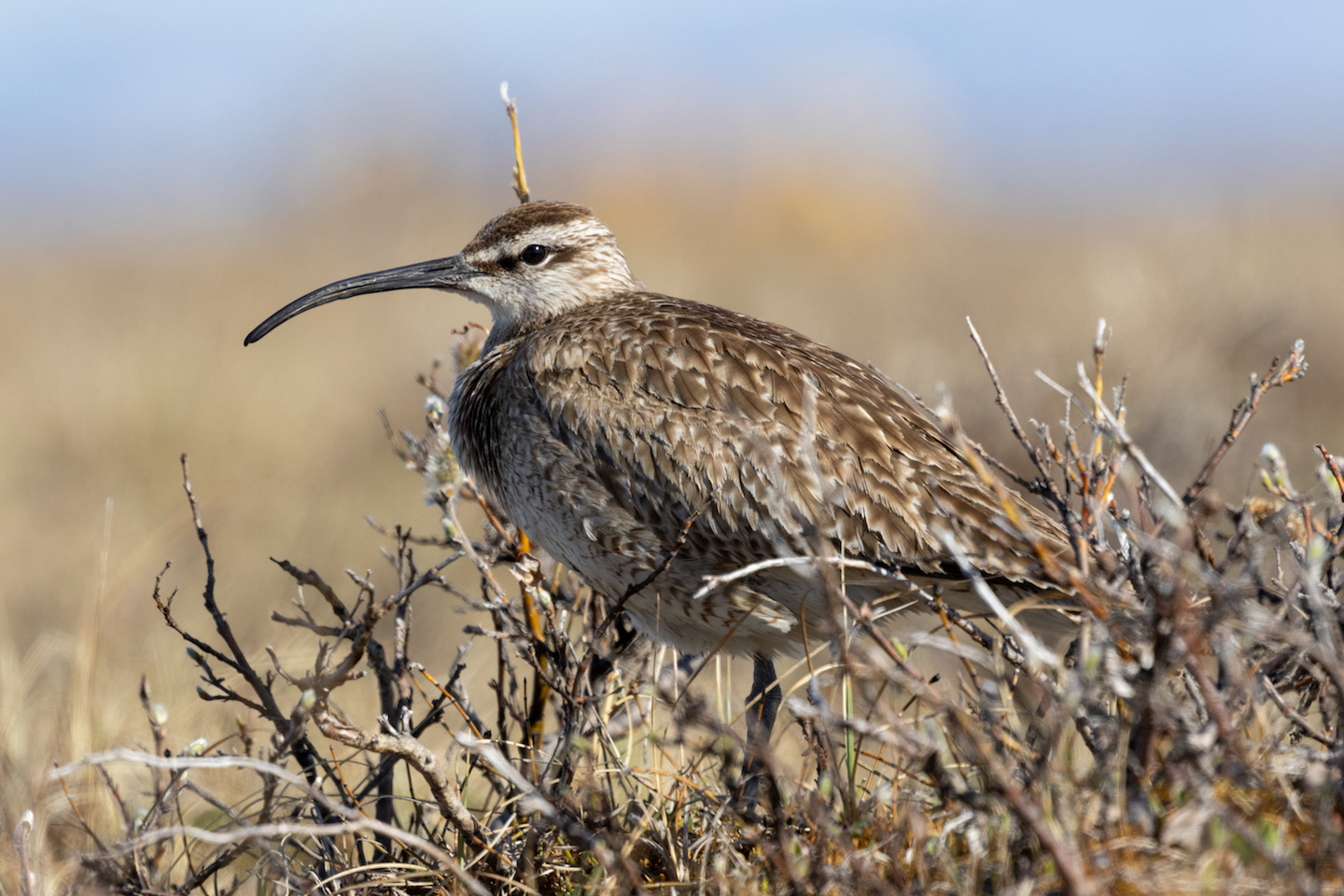
A whimbrel rests on a willow near the Jago River in summer 2024.
During a month of endless summer light, a mated pair of shorebirds teaches their four chicks how to catch insects. The babies grow fat and strong on the tundra high in northeastern Alaska. They are soon ready for their first migration.
On a random day, the male then jumps off the cushion of northern plants and, done with Alaska, flaps eastward. The female pivots and flies west.
The male whimbrel pauses for 25 days at Hudson Bay, continues over Nova Scotia and then follows the Atlantic coast on a nonstop journey to a wetland in Brazil.
The female cuts over the nose of the Seward Peninsula and stops for two weeks on the Yukon Kuskokwim river delta. The fattened bird then tracks the Pacific shoreline — resting a week in San Francisco Bay and then some at the mouth of the Colorado River — until it reaches Columbia.
The whimbrels winter apart on opposite coasts of South America.
The following summer, both birds reverse course, reaching northeastern Alaska in late May.
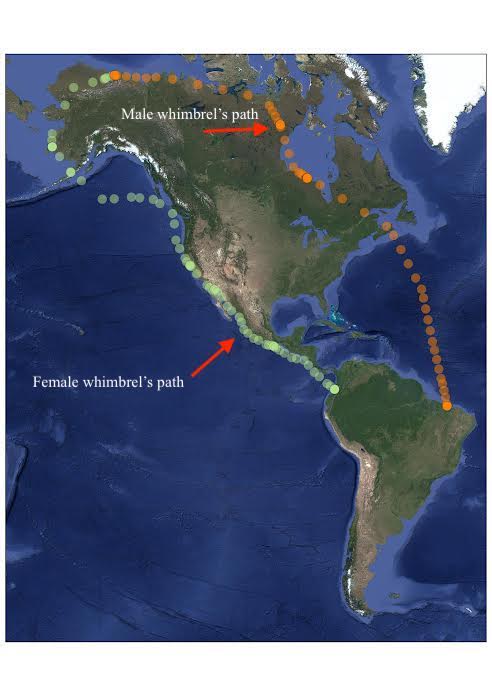
The map shows the divergent migration paths of a mated pair of whimbrels, shorebirds that migrate from South America to Alaska and back.
Hopping across a green bench above the Katakturuk River, they each recognize the other’s shape, perhaps a remembered scent.
Their love blossoms anew. The female soon lays four eggs in a shallow nest.
This Valentine’s Day story arrives via a biologist who is about to learn a lot more about the whimbrels of northeastern Alaska.
Dan Ruthrauff has studied the ptarmigan-size shorebirds with roundish bodies and long, curved beaks for years. He has held them in his hands within the Kanuti Wildlife Refuge in central Alaska’s boreal forest and the tundra off the Colville River in northern Alaska.
Ruthrauff, a longtime researcher with the U.S. Geological Survey Alaska Science Center in Anchorage, is taking over a study Shiloh Schulte initiated in Alaska’s Arctic National Wildlife Refuge a few years ago.
Schulte, who died in a helicopter crash last summer, was in the second year of a newly funded three-year study that included monitoring a mated pair of whimbrels he had radio tagged. To the astonishment of other researchers, Schulte found that the two whimbrels — birds that probably mate for life — migrated in fall via different coasts of the Americas, and wintered in different countries.
In January 2025, Ruthrauff retired earlier than he had anticipated from the USGS Science Center in Anchorage. He was one of many scientists who left that organization of excellence due to pressure from the U.S. Department of Government Efficiency.
A couple of months after a June 2025 helicopter crash near the Deadhorse airport took the life of biologist Shiloh Schulte and the helicopter’s pilot, a supervisor with Manomet Conservation Services of Massachusetts contacted Ruthrauff. He asked if Ruthrauff would consider extending Schulte’s work on the northern whimbrels, which can live to be 20 years old.
“The idea grew for me to work with the organization to help carry Shiloh’s work forward,” Ruthrauff said. “It was kind of a nice lifeline for me.”
Ruthrauff recalled a track from one of the birds he studied with his USGS colleagues. The whimbrel left a site near Quinhagak, on the mouth of the Kuskokwim River, and flew nonstop to a site in western Mexico, overflying the Baja Peninsula.
“This was over water the whole way, skipping Canada, the lower 48, and Baja,” Ruthrauff said. “This was 5,700 kilometers nonstop, over less than three and a half days.”
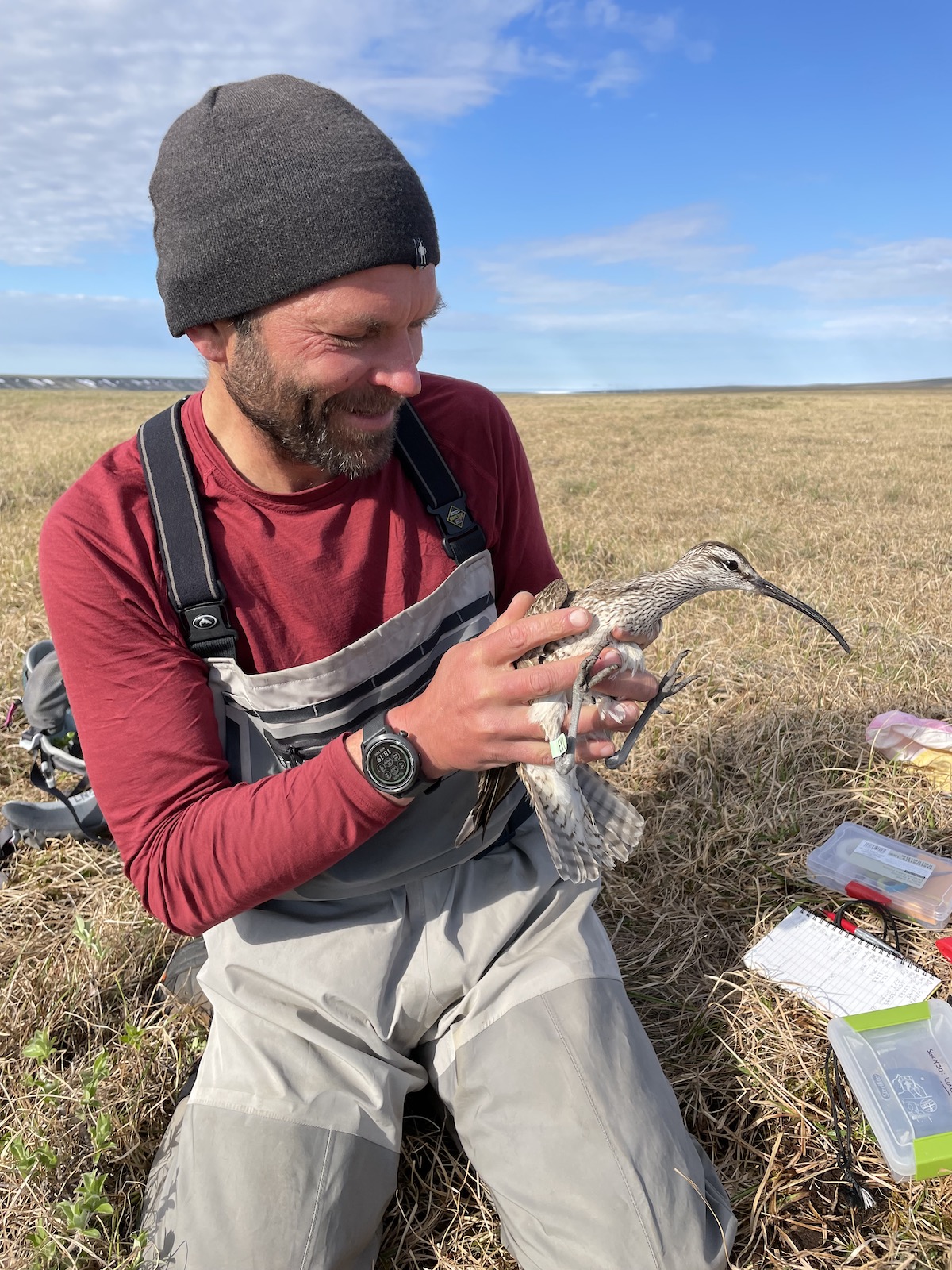
In 2021, the late Shiloh Schulte holds a whimbrel that nested above the Katakturuk River in northern Alaska.
Before Schulte found the mated pair that migrated via different ends of the continent, biologists thought that whimbrels that went east in fall might have been a different subspecies than the birds that headed west.
“We thought those birds were probably unlikely to breed,” Ruthrauff said.
But the birds have produced healthy chicks. Schulte found that a surprising three out of nine mated pairs of birds were composed of males that migrated by one ocean, females another.
That means two birds responsible for the same tiny nest on the tundra face dangers from the Caribbean and South America (where they are hunted for sport and food) as well as on the Pacific coast. Whimbrel numbers worldwide have declined by at least 70 percent over the last few decades.
“It shows the importance of these interconnected sites across the whole (western) hemisphere,” Ruthrauff said.
This summer, Ruthrauff will follow the whimbrels north to their nesting site near the Katakturuk River in the Arctic National Wildlife Refuge, which flows straight north from the Brooks Range into the Beaufort Sea. He wants to learn the birds’ life history and to find out where during their epic migration the birds face the most danger.
If he’s lucky, Ruthrauff may even witness the original long-distance couple that Schulte discovered, the plucky travelers once again reunited in northernmost Alaska.
Since the late 1970s, the University of Alaska Fairbanks' Geophysical Institute has provided this column free in cooperation with the UAF research community. Ned Rozell is a science writer for the Geophysical Institute.