
Building Lady Beetle Habitat into the Alaska Garden
HGA-00500 View this publication in PDF form to print or download.
by Alexandria Wenninger
Alaska is home to more than 30 species of lady beetles (also called ladybugs or ladybird beetles). Not all lady beetles are red with black spots. Alaska lady beetles come in an array of colors across the spectrum from yellow to red and are often accented with bold blacks and whites. Patterns range from spots and swirls to stripes and zig-zags.
Lady beetles are a type of beneficial insect called a natural enemy due to their role in pest control. Natural enemies help suppress populations of pest insects, which in turn reduces damage to crops and reduces the need for pesticide use. We can employ an integrated pest management practice called conservation biological control to increase the activity of these native predators in our gardens by enhancing the habitat to attract and sustain their populations.
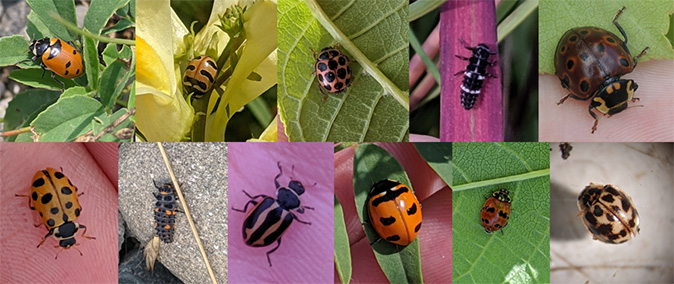
Lady Beetle Life Cycle
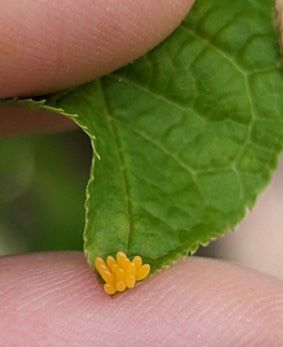
The lady beetle life cycle lasts for about one year in total and proceeds through four distinct stages: egg, larva, pupa and adult. Their oval-shaped eggs rangein color from cream to orange and are laid in clusters in spring or early summer, often on the stem or leaves of a plant that is also occupied by soft-bodied insect prey. The lady beetle is only in the egg stage for about a week before it emerges as a larva.
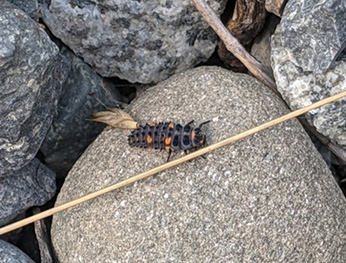
The larvae look quite different from the adult form; they have slender, tapered bodies with agile legs, reminiscent of tiny alligators. Their bodies are usually dark in color with orange or white markings, though some larvae are a pale gray color. Lady beetle larvae are voracious eaters, typically of other small invertebrates such as aphids, mites and insect eggs, but some species of lady beetle also feed on mildews and fungal spores. Lady beetles spend several weeks feeding and developing as larvae.
Once they have progressed through their larval development, they anchor themselves to a substrate, often a leaf or plant stem, to undergo pupation. The pupal stage is a stationary, nonfeeding stage of life during which the larval body undergoes many internal changes over a week or two, transforming it into its adult form.
The lady beetle adults are the form we are most familiar with, with their shiny, rounded wing covers, called elytra, adorned in bright colors and patterns. These bright colors are not just to make them pretty to look at, but also serve as a visual warning to predators that the lady beetle produces compounds that are harmful or distasteful, a strategy called aposematic coloration. When threatened, lady beetles have a couple of defense mechanisms they can employ. One strategy is to “play dead” by tucking their legs in tight to their bodies and dropping from the foliage. More dramatically, some lady beetles use a strategy called reflex bleeding in which they secrete an offensive-smelling yellowish fluid from their joints to deter predators. Adult lady beetles consume similar foods to their larvae but will also seek nectar and pollen from flowers, providing pollination services to plants in the process. Most lady beetle species overwinter as adults and emerge in spring to lay eggs, starting the cycle over.
Six Tips for Building Lady Beetle Habitat in the Garden
Plant a variety of flowers that produce blooms throughout the season. Adult lady beetles use pollen and nectar as alternative food resources. Flat, shallow flowers, such as yarrow, goldenrod and wild rose, provide an easy landing spot for lady beetles. Lady beetles are also attracted to many of the flowers found in herb gardens, including basil, mint, dill, coriander and thyme.
Leave some aphids be. Lady beetles need food to grow and reproduce, so removing too many aphids from the garden can also eliminate food resources. Flower gardens can be a good place to let some aphids be as opposed to having to tolerate aphids on your lettuce and broccoli. While it may seem counterintuitive to allow some pests to remain in our gardens, having a consistent source of food for lady beetles and other predatory insects helps maintain healthy populations of these beneficial insects ready to tackle emerging pest issues.
Create habitat complexity. Some lady beetles have preferences for specific habitats, so cultivating a variety of plants, including trees, shrubs and flower gardens, can help support a wide variety of lady beetles. Some species, such as the two-spotted lady beetle and the eye-spotted lady beetle, prefer to hunt in trees and shrubs, whereas others, such as the three-banded lady beetle and the thirteen-spotted lady beetle, prefer sunny flowers and grasses.
Provide overwintering shelter. Leave some leaf litter and brush in the area. These structural elements serve as protected areas where lady beetles can stay insulated and dry during the long winter. Perennial flower beds are a great place to incorporate overwintering habitat so that you can still practice proper sanitation of crop residues in your vegetable garden.
Be mindful of pesticide use. Be aware that many common pesticides marketed for the control of unwanted pests can also harm lady beetles. Reduce the use of broad-spectrum insecticides (e.g. pyrethroids, neonicotinoids, organophosphates, etc.) as much as possible by employing an integrated pest management approach. Use cultural and physical techniques to prevent pest issues up front and monitor regularly to catch problems early when they are easier to manage. If you do choose to use a pesticide, choose those with active ingredients that selectively target specific groups of insects and those that have lower residual activity to reduce nontarget impacts. Before purchasing and applying any pesticide product, read all label directions. Some labels will have specific application instructions to reduce harm to nontarget organisms.
Do not release commercially sold lady beetles outdoors. While many companies have marketed the non-native convergent lady beetle (Hippodamia convergens) to gardeners in Alaska, there are no approved permits for its importation to Alaska, and we strongly discourage its release for two reasons:
- Commercially sold H. convergens provide ineffective pest control. Convergent lady beetles are collected from their overwintering sites in the mountains of California. This strategy allows distributors to collect the beetles efficiently; however, this also means that when those lady beetles are released into your garden, their first instinct is to disperse, as they were about to do in the wild. When released into your garden, the majority of these lady beetles leave, offering little pest control service to the intended area.
- Releasing H. convergens risks harm to native lady beetles in Alaska. Because convergent lady beetles are wild-collected, they carry diseases and parasites
that can be transmitted to our wild lady beetles. These introduced lady beetles also
compete with native lady beetles and other beneficial insects for resources. While
these lady beetles are often marketed as an environmentally friendly alternative to
pesticides, in reality, they have a high potential to cause harm to our local ecology.
Photo Guide to Selected Lady Beetle Species found in Alaska
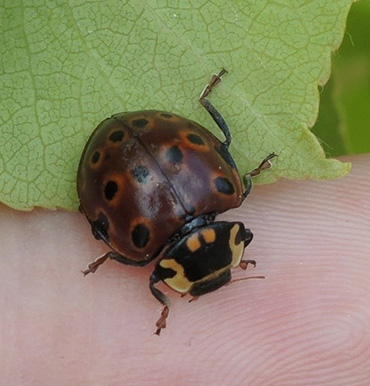
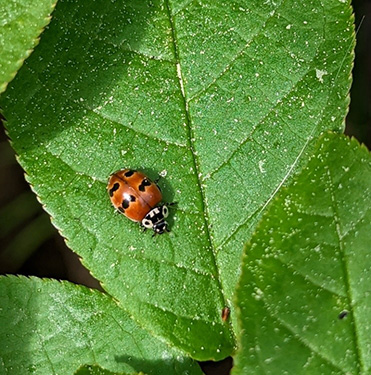
Eye-spotted lady beetle
Anatis mali
The eye-spotted lady beetle is one of the largest species of lady beetles in Alaska. This pretty giant can grow up to a centimeter long and features a red to brown body color with many black spots, each surrounded by a pale ring. This species is encountered throughout both Interior and Southcentral Alaska, though it is more commonly observed in the Interior. This lady beetle is an important predator of aphids and other small insects in trees, both in conifers and hardwoods. In spring, they are often observed on trunks of birch or aspen where their red bodies stand out against the white or gray tree bark, and in fall can be found nestled among clusters of highbush cranberries.
Two-spotted lady beetle
Adalia bipunctata
The name two-spotted lady beetle is a little bit of a misnomer. The typical form of this lady beetle has orange elytra, each with a single black spot. However, this species has a beautiful variety of color patterns, and different individuals may have from 0 to 14 spots. In Southcentral Alaska, the most common color morph has a row of spots in the middle of the elytra and another near the rear of the elytra, which are sometimes grouped into a wavy band, as shown in the photo.
The two-spotted lady beetle is 4-5 millimeters long and prefers hanging out in trees and shrubs where it feeds on aphids, mites, insect eggs and other small, soft-bodied insect prey. In spring, adults may also feed on pollen, nectar or honeydew for energy.
This species has been in decline in many parts of its native range, both in North America and in Europe. Factors such as habitat loss, pathogens, parasites, and competition from non-native lady beetles are thought to be causes for these declines. Hopefully, here in Alaska, we can learn from the impacts these factors have had elsewhere in the United States and prevent the same demise to our own two-spotted lady beetles.
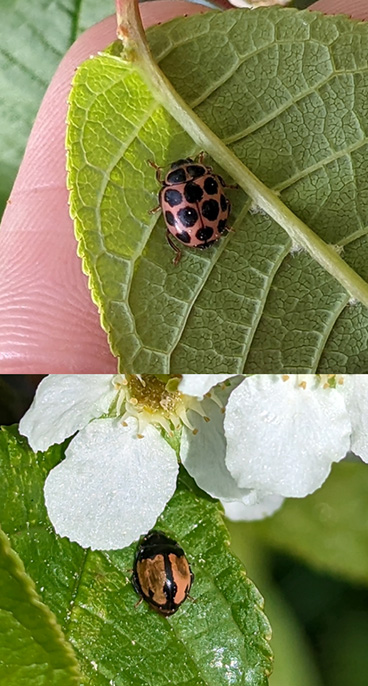
Cream-spotted lady beetle
Calvia quatuordecimguttata
The cream-spotted lady beetle is arguably Alaska’s most exciting lady beetle because of the wide variety of color patterns that characterize this species. The name “cream-spotted” comes from the color form of the species that is black in color and speckled with white to pink spots. However, in Alaska, this lady beetle also has another common color form that looks pink with black spots. To further complicate matters, sometimes the spots are coalesced into larger splotches or swirls, and sometimes red and brown spots are thrown into the mix.
The cream-spotted lady beetle emerges early in spring and tends to be arboreal, meaning it lives and feeds in trees. It can also be found on herbaceous plants, such as fireweed. It ranges in length from 4-5.5 millimeters and feeds on a variety of small arthropods, including aphids, psyllids and mites. This species is also sometimes called the “fourteen-spotted lady beetle,” although some sources have moved away from this name due to confusion with a European species that goes by the same common name. Check out the species’ BugGuide page (https://www.bugguide.net/node/view/26792) to see several more color variations.
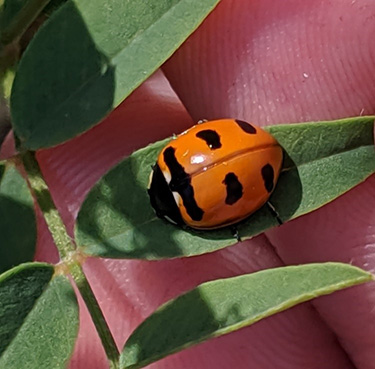
Transverse lady beetle
Coccinella transversoguttata richardsoni
The transverse lady beetle is one of the most commonly encountered lady beetles in Alaska. It gets its name from the wide, horizontal band near the front of its gold to red elytra. The transverse lady beetle is fairly large at 5-8 millimeters. It does well in a variety of habitats, including forests, meadows, parks, gardens and agricultural fields, where it feeds predominantly on aphids but also other small, soft-bodied arthropods.
Other parts of North America have reported remarkable declines in the transverse lady beetle after the introduction of non-native lady beetle species, including the seven-spotted lady beetle and the multicolored Asian lady beetle. Once abundant throughout Canada, the transverse lady beetle has not been detected in more than two decades across five Canadian provinces, and has been reduced to small populations in four others. The seven-spotted lady beetle has begun to show up in urban areas of Alaska, which has sparked some concern about the potential for negative impacts on the native transverse lady beetle population.
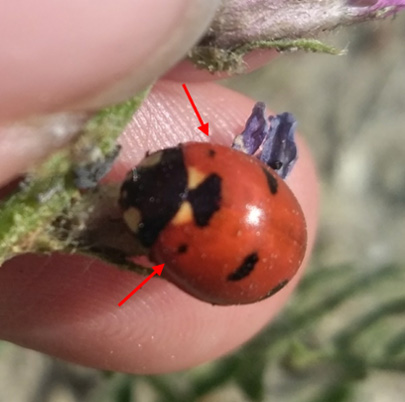
Native transverse lady beetle with an anterior transverse band reduced to a central spot with two minute, lateral spots, indicated by arrows. Take care not to confuse this color form with the non-native seven-spotted lady beetle.
Three-banded lady beetle
Coccinella trifasciata perplexa
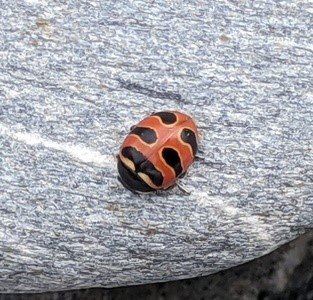
The three-banded lady beetle has orange to red elytra that feature a wide, black band across the anterior, as well as a divided band at the middle and hind end of the elytra. The black bands are often surrounded by a pale, yellow ring. This species has been observed as early as April and as late as October in Alaska, and is found throughout both Interior and Southcentral Alaska. The three-banded lady beetle is 4-5 millimeters long and largely feeds on aphids in a variety of shrubs, flowers and grasses.
Thirteen-spotted lady beetle
Hippodamia tredecimpunctata tibialis
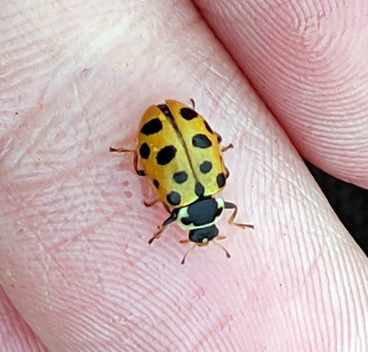
The thirteen-spotted lady beetle is characterized by 13 small, black spots on its gold to orange elytra. In some cases, the three spots near the center/anterior of the elytra may be fused together, giving the appearance of fewer than 13 spots. The thirteen-spotted lady beetle is rather oblong in shape and reaches 4.5-6.5 millimeters in length.
This species prefers marshy habitats and meadows, often associated with lakesides, river deltas and floodplains. The thirteen-spotted lady beetle is most often found on grasses and sedges, where it feeds on aphids, but it can also be found in some crop systems or in gardens. This species is found throughout most of the Northern hemisphere; however, it is in serious decline in some parts of Eastern Canada. The decline of the thirteen-spotted lady beetle has been associated with changes in land use and the introduction of non-native lady beetles.
Five-spotted lady beetle
Hippodamia quinquesignata quinquesignata
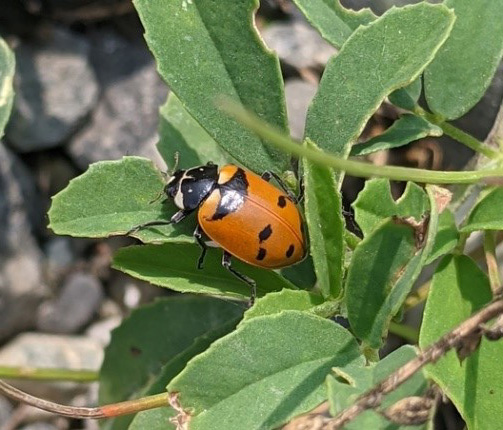
The five-spotted lady beetle typically has 4-6 smaller black spots on its gold to orange elytra, as well as a transverse band near the top of the elytra. Sometimes this species has no spots, coalesced spots or a missing band. Because of that transverse band, this species is easily confused with the transverse lady beetle mentioned earlier. However, the body form of the five-spotted lady beetle is a bit more elongate compared to the more rounded shape of the transverse lady beetle. This species is variable in length, ranging from 4-7 millimeters.
This species prefers meadow, grassland and cropland habitats where it feeds on aphids and other small, soft-bodied prey. These lady beetles can also be found associated with invasive white sweetclover in Interior and Southcentral Alaska.
Sickle-marked lady beetle
Hippodamia falcigera
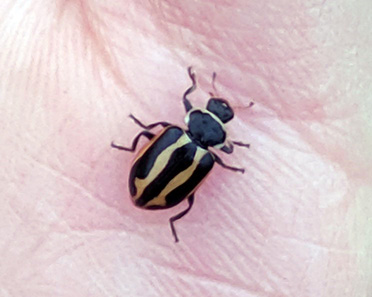
The sickle-marked lady beetle bears stripes rather than spots. The elytra are yellow to gold in color and feature three dark longitudinal stripes – one down the center that tapers near the end, and one on each elytron that makes a small, sickle-like curl near the end. This is a medium-sized lady beetle at 5-6 millimeters in length. The sickle-marked lady beetle is typically found in wet, marshy habitats where it feeds predominantly on aphids but can also be found in association with cropland.
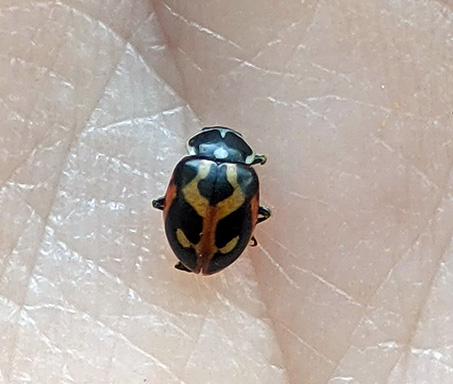
Parenthesis lady beetle
Hippodamia parenthesis
The parenthesis lady beetle has yellow to orange elytra that each bear a large, dark curl, reminiscent of a pair of parentheses (). This medium-sized lady beetle ranges from 3.8-5.6 millimeters in length. The parenthesis lady beetle is found in a range of habitats, including meadows, grasslands, croplands and gardens, where it feeds predominantly on aphids but also on other small, soft-bodied prey. The beetle in the photo is feigning death by tucking its head and legs close to its body.
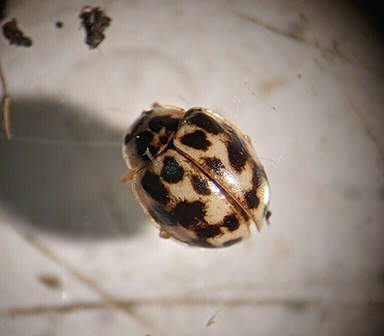
Twenty-spotted lady beetle
Psyllobora vigintimaculata
The twenty-spotted lady beetle is one of the smallest species of lady beetles in Alaska. This little beauty measures in at only 1.75-3 millimeters long, which is only about a third of the size of our largest lady beetle species, the eye-spotted lady beetle. The twenty-spotted lady beetle is cream-colored with many dark brown spots that often merge into zig-zag-like patterns.
The twenty-spotted lady beetle differs from many of the aforementioned species in that it feeds predominantly on fungi. This species is often found on shrubs and other vegetation, feeding on powdery mildews and their spores from leaf surfaces.
Invasive Species Alert!
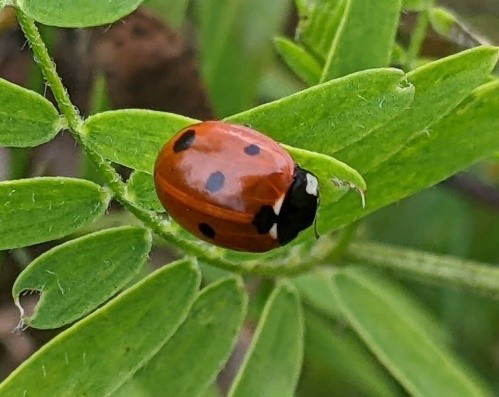
Seven-spotted lady beetle
Coccinella septempunctata
The seven-spotted lady beetle is a non-native species that has been found in several urban areas of Southcentral and Southeast Alaska. This large-bodied species (6.5-8 millimeters) has orange to red elytra dotted by one central spot anteriorly and three smaller spots on each of the two elytra.
Originally introduced from Europe to North America, this species has since spread throughout much of the United States and Canada and is considered invasive due to its competition with key native species. This has resulted in a reduction in native lady beetle populations, especially larger, aphid-feeding species such as the two-spotted lady beetle and the transverse lady beetle.
Lady Beetle Look-a-likes
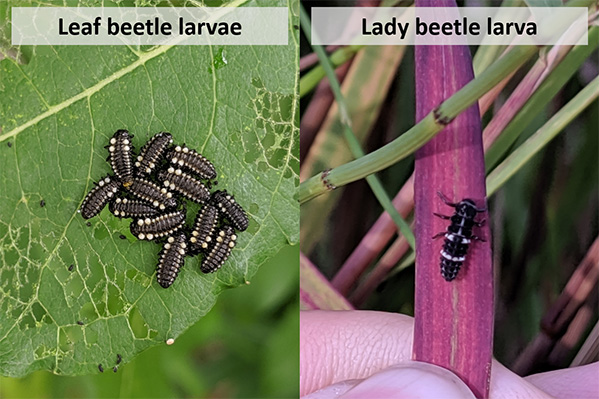
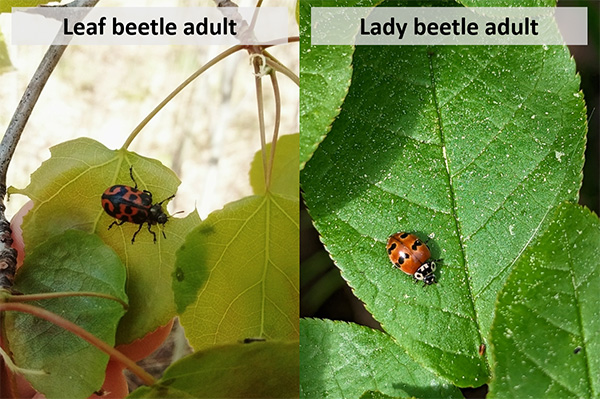
Lady beetles are often confused with leaf beetles (Chrysomela species) in Alaska based on appearance. Lady beetle larvae typically have longer, more slender legs, whereas leaf beetle larvae have shorter legs. Leaf beetle larvae also differ in that they are often found in aggregations and are associated with feeding damage on trees or shrubs, especially cottonwood.
Adult leaf beetles also have similar coloration as adult lady beetles, however, their bodies tend to be larger and more elongate than most of our lady beetles.
Additional Resources
If you are interested in exploring observations of lady beetles in Alaska or would like to contribute observations of your own, please join the Alaska Lady Beetle Community Science Project on iNaturalist.
Community science helps us better understand the diversity and distribution of native lady beetles in Alaska. Community science also helps us monitor the spread of non-native species of lady beetles in Alaska.
Contributing data is easy – if you see a lady beetle while enjoying the outdoors, snap a photo and upload it via the iNaturalist app or desktop site: all lady beetles uploaded to the platform from Alaska will automatically be included in the project. https://www.inaturalist.org/projects/alaska-lady-beetle-community-science-project
Gordon, Robert D. 1985. “The Coccinellidae of America North of Mexico.” Journal of the New York Entomological Society 93: 1-912.
Hopwood, Jennifer, Eric Lee-Mäder, Lora Morandin, Mace Vaughan, Claire Kremen, Jessa Kay Cruz, James Eckberg, Sarah Foltz Jordan, Kelly Gill, Thelma Heidel-Baker and Sara Morris. 2016. “Habitat Planning for Beneficial Insects, Guidelines for Conservation Biological Control.” Xerces Society for Invertebrate Conservation. https://xerces.org/sites/default/files/2018-05/16-020_01_XercesSoc_Habitat-Planning-for-Beneficial-Insects_web.pdf
Jepsen, Sarina and Scott Hoffman Black. 2014. “Potential risks of releasing native lady beetles.” Xerces Society for Invertebrate Conservation. https://xerces.org/sites/default/files/publications/18-019_01_Xerces%20Society%20Lady%20Beetle%20Release%20Statement.pdf
Acknowledgments
Alexandria Wenninger, IPM Research Professional
(All photos were taken by the author.)
This work is supported by the Crop Protection and Pest Management Program (grant no. 2024-70006-43668) from the USDA National Institute of Food and Agriculture.
New April 2026