Carrots are among the most popular vegetables. Those grown in Alaska are high in quality due to a greater accumulation of sugars in the root. Bitterness is unknown because Aster Yellows, a virus disease occurring in other areas, is not found here.
The carrot (Daucus carota var. sativa) was introduced from Europe and is well adapted to our growing conditions. It is a biennial that is an excellent source of vitamins A, B, C, and G (B2). Arizona, California, and New Mexico produce most of the fresh carrots, and the northern states produce most of the processing carrots in America.
Long (10 to 12 inch), slender types are the most popular fresh carrots. These types may not have the flavor of Alaskan carrots, but are the ones that most grocery shoppers buy. The Nantes type is only slightly larger in diameter and is very uniform throughout its length (six to seven inches). The shorter thicker types, such as Chantenay and the extremely short French Forcing carrots, are grown for home use and processing. These last types are best suited for the cold soils of Alaska, but long, slender carrots are in greater demand.
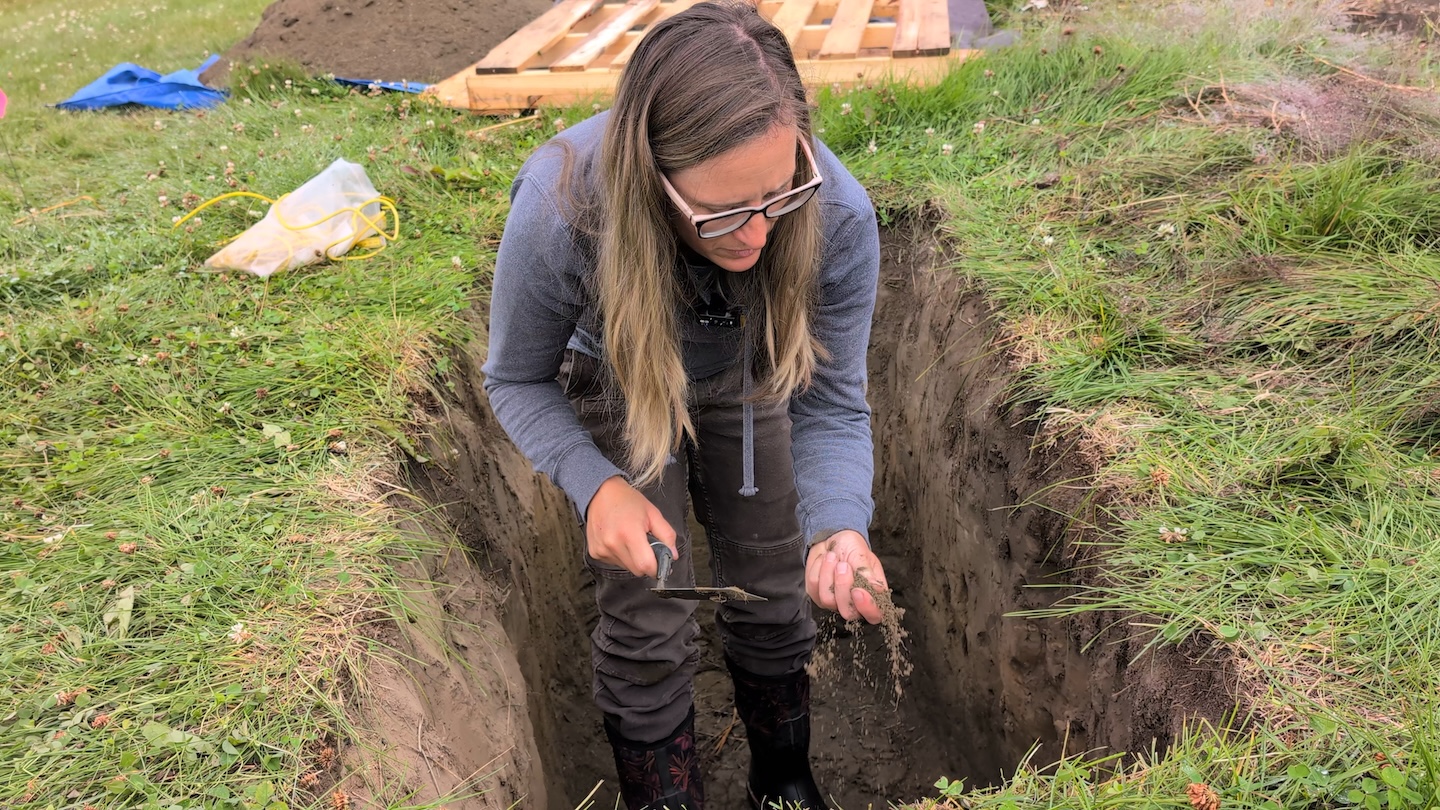
Carrots develop best in warm, loose, well drained deep silt or sandy loam. Compact, cold, poorly drained soils cause crooked, forked roots and heavy tops. Alaskan soils can be prepared to meet preferred conditions by rototilling and mounding or ridging.
Mounded rows should be 10 to 12 inches high and 12 inches wide at the top. The mound sides should be at right angles to the sun's rays to gather the most heat. Rows should run north and south to expose both sides of the mound to the sun during the course of the day. The few degrees gained in soil heat this way are important. Carrots do well in cool climates but not in cold soils. Soil acidity (pH) should be from 6.5 to 7.0 pH. Yields may drop off rapidly at lower pH readings, because phosphorous is not as available at lower pH values.
It requires three pounds of seed to plant an acre of carrots. If pelleted seed is used, the actual weight will be less. Seeds should be covered uniformly not more than one-half inch deep. Place soil firmly over seed to ensure good contact. Carrots are slow to germinate: in 50F soil, they require approximately 18 days; in 60F soil, approximately 12 days. Soil moisture is important during planting to ensure that the seeds germinate when planted at a shallow depth. Planting the seeds deeper to ensure an adequate moisture supply is not satisfactory because the weaker seeds may never push a sprout above ground. Shallow planting and providing moisture in this shallow layer are both very important for rapid plant emergence.
When the stand has fully emerged, do not delay thinning. Thin carrots two inches apart as soon as strong growth is established.
Alaska soils are generally low in phosphorous. You should plan to supply the entire needs of the crop from commercial fertilizer. One thousand pounds per acre of 8-32-16 analysis fertilizer may be required. Soil testing should be used to determine exact fertilizer requirements. Broadcast half of the total amount of fertilizer before rototilling to ensure fertilization throughout the root zone. Place the remaining half of the fertilizer at the center of the double rows. It is advisable to apply additional nitrogen in regions of heavy rainfall before the early summer growth decline period. Uniform, rapid growth produces quality carrots.
Commercial carrot production should not be attempted unless supplemental water is available by some reliable method. Early moisture is the most important for carrot production. Later irrigation should be timed to obtain maximum benefits from a sound chemical weed control program.
Chemical weed control is recommended for carrot grower's use. Carrot leaves grow slowly and are lacy. They are not able to compete with broad-leaved weeds or grasses or to shade them out. It is imperative that weed competition be eliminated. Linuron is the most effective chemical for killing weeds in carrots. It can be applied at an early stage of carrot plant growth. Generally, it is more effective to apply the spray in relation to weed development rather than to carrot plant growth, except that carrots in the early cotyledon stage are less resistant to herbicide damage than they are when they have developed a true leaf.
Occasionally, there will be a dense cover of weeds before the carrot plants are visible. In this case, the weed development rather than carrot plant size should determine the need for spraying. A dense mat of weeds will screen most of the spray from the underlying carrot seedlings, which are actually more resistant to the spray than are the weeds. Linuron, at a maximum of two pounds of active ingredient per acre in at least 100 gallons of water per acre, gives good coverage and weed control. As with all pesticides, be sure to follow precautions as stated on the container label.
If the soil has been well-prepared and is not a heavy clay type, cultivation before seeds are planted is unnecessary. Cultivation permits weed seed to germinate by bringing it to the surface, and it allows increased soil drying, which results in a need for irrigation. As the shoulder of the carrot roots enlarge, they may become exposed to light and develop an undesirable "greening." Prior to this exposure, cultivation to throw the soil up against the carrot stem is necessary to maintain a high quality crop.
No specific control measures are currently needed in Alaska.
A good commercial yield of carrots runs between 15 and 20 tons per acre; two to two and a half pounds per foot of row. Alaskan yields can meet or exceed this under good management.
The harvested root should be handled carefully to prevent bruising and be placed in cold storage immediately after harvesting. The ideal storage temperature is 32F. Relative humidity should be maintained at 90 to 95 percent, but avoid condensation or water dripping from the ceiling. For the grower with small quantities of carrots or inadequate humidity control facilities, layering carrots in damp (not wet) sand will retain firmness and minimize shrinkage due to fungal attack or evaporation.
Carrots may be washed at harvest time, but no water should be on the surface when the root goes into storage.
The carrots that are offered to the consumer are attractive, clean, U. S. Grade A products, and all carrots within a package are uniform in diameter and color. The grower must be able to produce consistently high quality carrots or he cannot hope to compete in this market.
Alaskan grown carrots have an advantage over carrots that are shipped into the state, because they generally have a higher sugar content when they reach the marketplace. The food storage product of carrots is mainly sucrose. This accounts for the pleasing taste of Alaskan grown carrots.
Uniform, dependable service to the retailer is almost as important as the product itself. The retailer must have a dependable supply of carrots as required.
Other options for a grower include farmers markets or roadside stands. Knowledge of local marketability is an important prerequisite before pursuing these options.
This publication was originally developed in 1970 by Alan C. Epps, Extension Horticulturist, University of Alaska. In 1981 this publication was revised by Wayne Vandre, Horticulture Specialist, Cooperative Extension Service, and Curtis Dearborn, Ph.D., Research Horticulturist, Science and Education Administration, USDA. Wayne Vandre has approved this publication for reprint in 1997.
CES Communications-02-17-99
The University of Alaska Fairbanks Cooperative Extension Service programs are available to all, without regard to race, color, age, sex, creed, national origin, or disability and in accordance with all applicable federal laws. Provided in furtherance of Cooperative Extension work, acts of May 8 and June 30, 1914, in cooperation with the U.S. Department of Agriculture, Anthony T. Nakazawa, Director, Cooperative Extension Service, University of Alaska Fairbanks.