Research, workforce development and economic growth news stories and other feature
articles from the University of Alaska Anchorage, University of Alaska Fairbanks,
University of Alaska Southeast, University of Alaska System Office and the UA Foundation.Compiled by the University of Alaska System Office of Public Affairs.
Talk of a takeover of Greenland may seem fanciful. But it wouldn’t be the first time
the U.S. was able to procure a piece of the Arctic. The U.S. bought Alaska from Russia
in 1867. We asked William L. Iggiagruk Hensley, a visiting professor at the University of Alaska Anchorage, to write about that
historic sale. This is the article we published then, with minor updates.
"As a descendant of Inupiaq Eskimos,I have been living and studying this history all
my life. In a way, there are two histories of how Alaska came to be American – and
two perspectives."
The recent opening of Mat-Su College (MSC)’s new state-of-the-art educational suite
for its veterinary technology program marks a major step forward in animal care education for Alaska. More than just a
training facility, this space represents years of collaboration and dedication from
educators, veterinary professionals and the local community — all working toward a
shared goal: preparing the next generation of veterinary technicians.
In fall 2019, theUAA Esports Lounge opened on the Student Union’s second floor with a simple goal: to create a space for students
to come together, compete and engage with the rapidly growing world of esports. What
started as a student-driven initiative supported by Student Affairs, has since evolved
into a hub for competitive gaming, community building and collaboration — both on
and off campus.
Scientists have produced the first remote sensing analysis of how water clouded by
sediment in glacier meltwater moves on the surface of Kachemak Bay.
Work led by Lea Hartl of the Alaska Climate Research Center at the University of Alaska
Fairbanks Geophysical Institute helps explain how surface turbidity, or cloudiness,
from glacial meltwater spreads in the bay throughout the year.
Multiple glacial streams carry turbid glacial runoff into Kachemak Bay in this aerial
view looking southwest from the head of the bay toward Homer on June 30, 2021. (Photo
by Geophysical Institute/Martin Stuefer)
The U.S. Department of Energy announced last week it was dedicating $45 million toward
advancing the domestic supply of critical minerals. $7.5 million of that will go to
the University of Alaska Fairbanks for research into Alaska’s critical mineral potential.
Wooller, aprofessorat UAF’s College of Fisheries and Ocean Sciences and director of the university’s
stable isotope laboratory, used chemical analysis to show that the pike that colonized
Vogel Lake got there after swimming in the marine saltwater of Cook Inlet.
The Vogel Lake discovery was followed in 2022 by discoveries of invasive pike in two
more estuaries: Westchester Lagoon and Campbell Lake in Anchorage, events also analyzed
in the study, which is coauthored by Dunker and others.
A team of interdisciplinary researchers from the University of Alaska Southeast, the
University of Alaska Fairbanks, and Carnegie Mellon University has been awarded a
$990,437 federal grant from the U.S. National Science Foundation.
The scholarship fund provides a minimum award of $3,000 per student. “For me, our
Environmental Science Endowment Fund is personal,” said Pete Strow, Coeur Alaska’s
Environmental Manager.
Dr. Twitchell is a writer and advisor for the animated PBS Kids program Molly of Denali,
nominated by the National Academy of Television Arts and Sciences (NATAS) for the
third annual Children’s & Family Emmy® Awards.
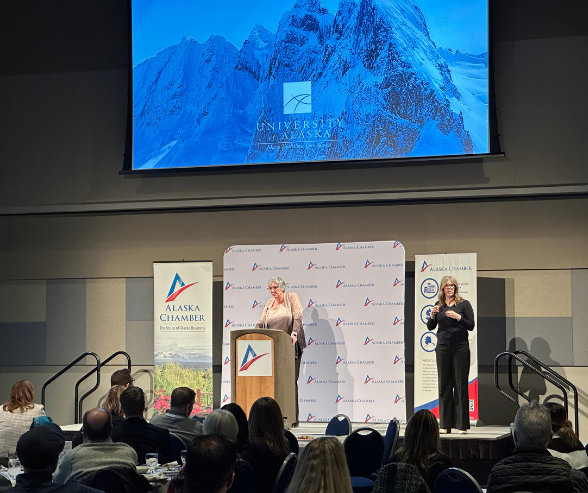
University of Alaska President Pat Pitney focused on the university’s critical role
in retaining talent and driving the state’s research, workforce and economic development
in the recent annual State of the University address.
But Pitney acknowledged in the Jan. 30 speech that there are “headwinds” and challenges,
like the numbers of high school graduates declining, rising costs, and the uncertainty
ignited by recent federal executive orders and potential budget cuts.
The University of Alaska administration and the union representing nearly 1,100 faculty
and postdoctoral fellows have reached a tentative agreement for a new three-year contract.
The deal announced Wednesday includes across-the-board salary increases each year
and a boost to minimum salaries.
Applications are open until March 1 for the Rural Alaska Honors Institute (RAHI),
a program that provides Alaska Native and rural Alaskans with the opportunity to get
a jump start on college courses.
Students in the program select from a list of 15 different courses and take five classes
in a six-week session at the University of Alaska Fairbanks.
The University of Alaska (www.alaska.edu) is an equal opportunity/equal access employer and educational institution. The university is committed to a policy of nondiscrimination (www.alaska.edu/nondiscrimination) against individuals on the basis of any legally protected status.Unsubscribe


 "As a descendant of Inupiaq Eskimos,I have been living and studying this history all
my life. In a way, there are two histories of how Alaska came to be American – and
two perspectives."
"As a descendant of Inupiaq Eskimos,I have been living and studying this history all
my life. In a way, there are two histories of how Alaska came to be American – and
two perspectives."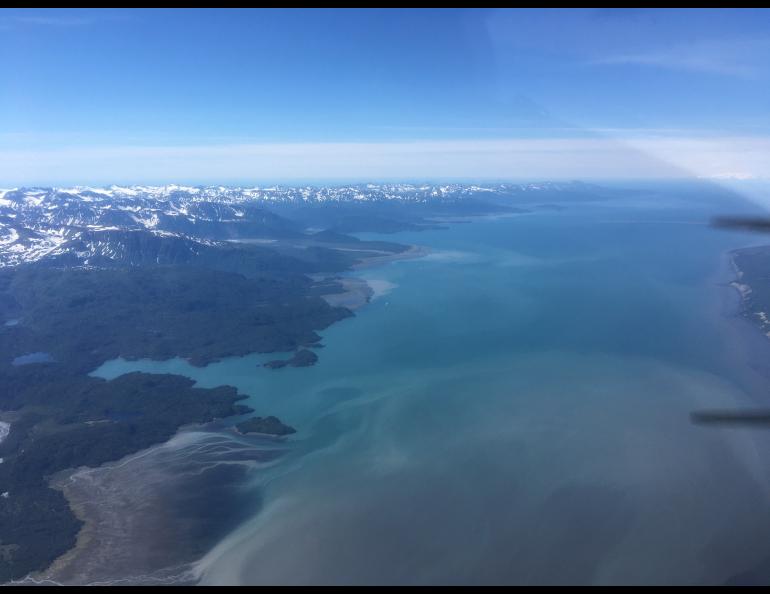 Multiple glacial streams carry turbid glacial runoff into Kachemak Bay in this aerial
view looking southwest from the head of the bay toward Homer on June 30, 2021. (Photo
by Geophysical Institute/Martin Stuefer)
Multiple glacial streams carry turbid glacial runoff into Kachemak Bay in this aerial
view looking southwest from the head of the bay toward Homer on June 30, 2021. (Photo
by Geophysical Institute/Martin Stuefer) Researchers will use field and remote sensing data to help model the evolution of
Mendenhall Glacier and its impact on outburst flood dynamics.
Researchers will use field and remote sensing data to help model the evolution of
Mendenhall Glacier and its impact on outburst flood dynamics.