Header Logo

newswire

December 3, 2024

Research, workforce development and economic growth news stories and other feature articles from the University of Alaska Anchorage, University of Alaska Fairbanks, University of Alaska Southeast, University of Alaska System Office and the UA Foundation. Compiled by the University of Alaska System Office of Public Affairs.

University of Alaska Anchorage

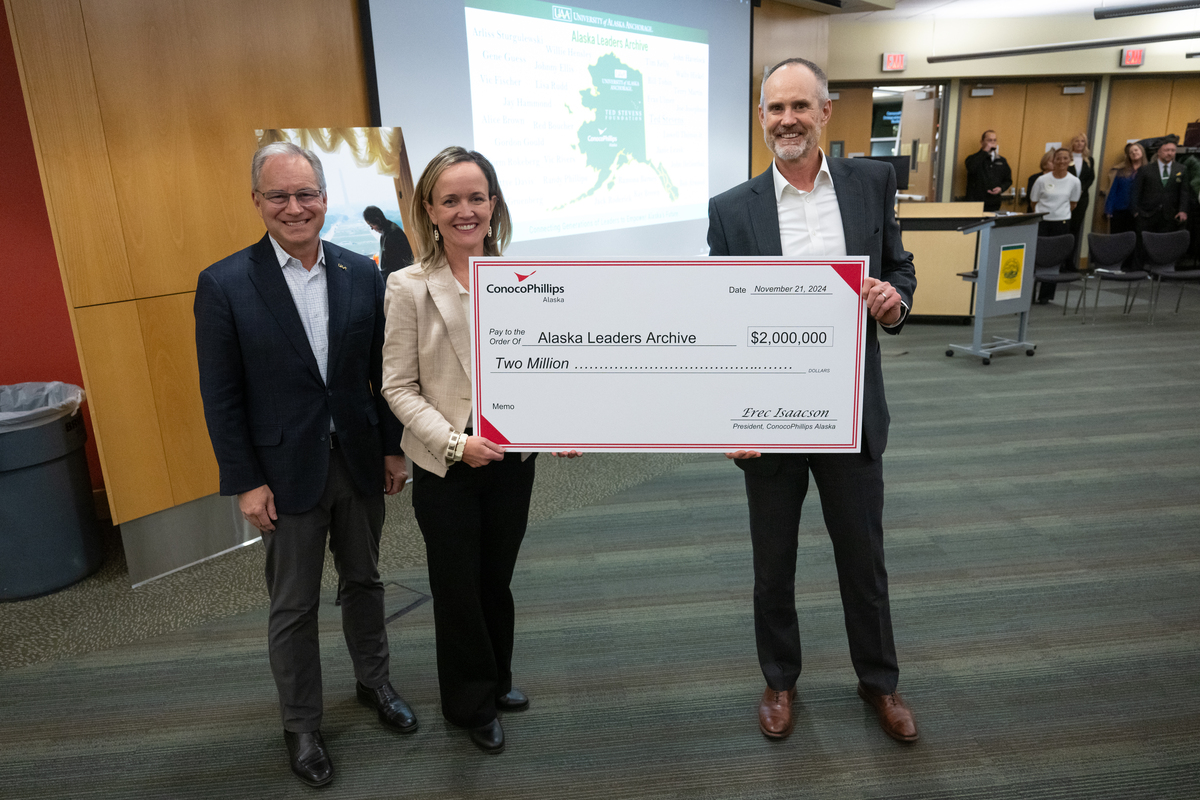
ConocoPhillips Alaska donates $2 million to create the Alaska Leaders Archive at UAA

The Alaska Leaders Archive project was launched in 2023 with the gift of the records of Sen. Ted Stevens to UAA by the Ted Stevens Foundation. The Stevens collection is one of the largest congressional archives in history.

The records document the transition of Alaska from a territory to a state and the important legislative accomplishments of Sen. Ted Stevens during his 40 years of public service. 

Contact: Austin Osborne

Chancellor Sean Parnell,  Lily Stevens Becker, Sen. Stevens’ daughter and executive director of the Ted Stevens Foundation, and ConocoPhillips Alaska President Erec Isaacson with a checkChancellor Sean Parnell, Lily Stevens Becker, Sen. Stevens’ daughter and executive director of the Ted Stevens Foundation, and ConocoPhillips Alaska President Erec Isaacson with a check. (Photo by James Evans / University of Alaska Anchorage)


‘Kindness is contagious’: Every Alaskan has a story

The Seawolf Food Pantry at the University of Alaska Anchorage started as an idea generated by the school’s Hunger and Homelessness Support Network, said Amanda Walch, associate professor in dietetics and nutrition. She and a colleague started work on getting approval for the project.

Then a survey by UAA Faculty found that 44% of students face “some form of food insecurity” while in school. Those findings — far higher than the state’s estimated food insecurity — gave the project new urgency. After working through some COVID-related delays, the food pantry launched in March 2022.

Contact: Austin Osborne


Learning more about Alaska’s elusive Pacific sleeper shark

Meet the Pacific sleeper shark, a seemingly laid-back fish that tries to stay out of others’ way and has been dubbed “big tubs of goo” by one scientist.

“I don’t think I would go that extreme,” said University of Alaska Anchorage assistant professor Amy Bishop, referencing the quote by another scientist. “But they are incredibly docile that when they come to the surface, you get this sense that they are this very old, very slow-lived animal.”

Contact: Austin Osborne


University of Alaska Fairbanks

Drones Take Science to New Heights: UAF Research at AGU24

Scientists from the University of Alaska Fairbanks (UAF) Geophysical Institute are leveraging drone technology to push the boundaries of research in challenging environments. At the 2024 American Geophysical Union (AGU) Fall Meeting, UAF researchers will present innovative projects showcasing drones’ capabilities in measuring snow and sea ice, surveying the sea floor, and educating remote communities in Alaska.

Contact: Marmian Grimes

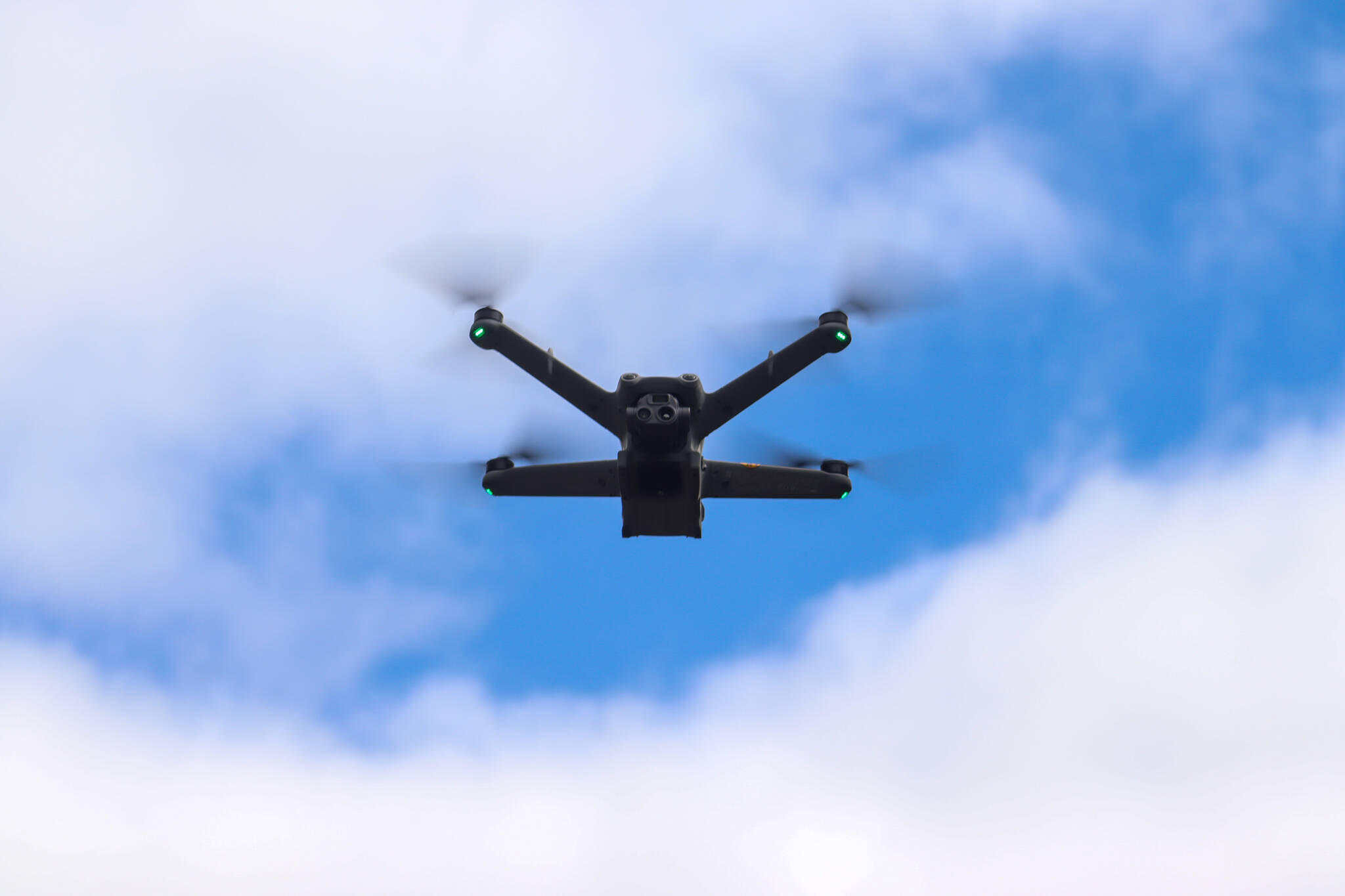
A drone against a blue skyA drone takes flight in Alaska during a demonstration. (Photo: UA)


Countdown to an ice-free Arctic: New research warns of accelerated timelines

For the first time, an international research team, including University of Colorado Boulder climatologist Alexandra Jahn and Céline Heuzé from the University of Gothenburg in Sweden, used computer models to predict when the first ice-free day could occur in the northernmost ocean. 

But the Arctic has been warming twice as fast as the rest of the world. In some seasons, it has warmed three times faster than the rest of the globe, said University of Alaska at Fairbanks scientist John Walsh.  

Contact: Marmian Grimes


After studying earthquakes in Alaska for 30 years, seismologist is moving on to a big new job

Ruppert took advantage of that freedom by applying to study at the University of Alaska Fairbanks. She soon arrived here to begin working on a master’s degree at the Geophysical Institute with the late professor Niren Biswas.

“(Being a Russian scientist in the U.S.) was a novelty at the time, but I received a good education despite all the problems in the Soviet Union,” she said during a recent interview.

Contact: Rod Boyce


University of Alaska Southeast

Scientists Are Crafting Fake Whale Poop and Dumping It in the Ocean

Plumes of whale poop, says Heidi Pearson, a marine biologist at the University of Alaska Southeast, contain nutrient concentrations three to seven times higher than typical seawater: “They make the ocean more productive in general.”

Through photosynthesis, all of this phytoplankton gobbles up roughly 22 million metric tons of carbon dioxide each year—the amount emitted by about 4.8 million vehicles in a year. When the phytoplankton die and sink to the seafloor, some of this carbon is locked away for the long term.

Contact: Elizabeth Cornejo

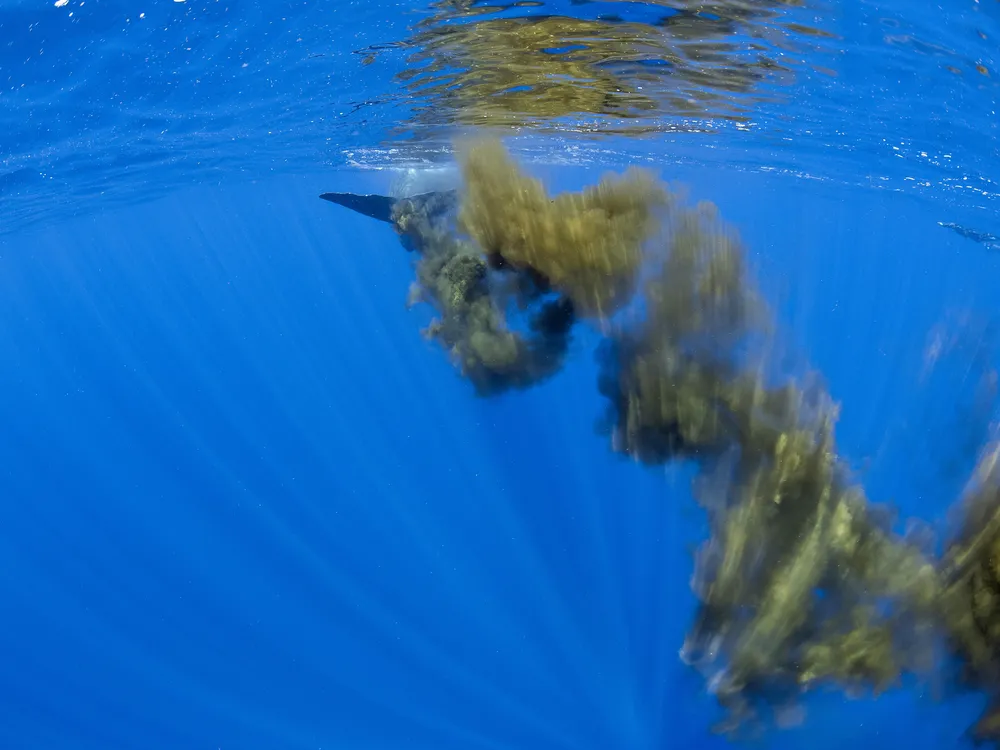
A sperm whale swims away, leaving behind fecesA sperm whale swims away, leaving a cloud of feces. (Photo: Blue Planet Archive/Alamy)


Southeast programs receive federal grants for Indigenous knowledge of fisheries

Two Southeast Alaska Native organizations are among seven entities that will share in $1 million in federal grant funds to support multi-year projects through the Alaska Fisheries Science Center Indigenous Engagement Program.

Sealaska Heritage Institute was awarded $110,000 to use Indigenous knowledge to document changes in the ocean and marine ecosystems from human and climate-related impacts, to better understand their effects on subsistence resource systems in Native communities.

Contact: Elizabeth Cornejo


Among butter clams, which pose toxin dangers to Alaska harvesters, size matters, study indicates

Butter clams, important to many Alaskans’ diets, are notorious for being sources of the toxin that causes sometimes-deadly paralytic shellfish poisoning.

Now a new study is providing information that might help people harvest the clams more safely and monitor the toxin levels more effectively.

The study, led by University of Alaska Southeast researchers, found that the meat in larger butter clams have higher concentrations of the algal toxin that causes PSP, than does the meat in smaller clams.

Contact: Elizabeth Cornejo


UA System Office

Explore the physics of snow in statewide webinar

Learn about snow physics and how snowdrifts form — and why it is possible to walk on a snowdrift – in a statewide webinar hosted by the University of Alaska Fairbanks Cooperative Extension Service.

The free webinar will be from noon-1 p.m. on Wednesday, Dec. 4.

Contact: Molly Johansson

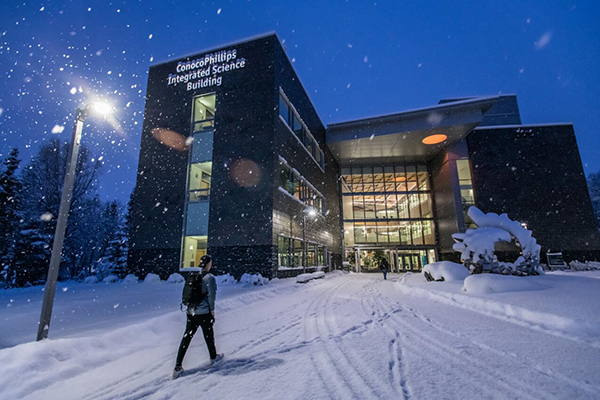
winter at UAF campusDuring “Catch the Drift: Measuring Snow and Water Equivalent,” participants will learn how to measure snow depth and calculate snow-water equivalent using Global Learning and Observations to Benefit the Environment, a worldwide citizen science program. (Photo: UAA)


UA Board of Regents approve $365 million state funding ask

The University of Alaska Board of Regents voted in favor of a $365.6 million funding request from the state at its meeting on Friday.

The ask is $35.6 million more than what was requested last year, according to a UA news release. This includes $24.1 million to cover the rising price of fixed costs as well as $10.4 million to improve recruitment, graduation and retention for students.

Contact: Jonathon Taylor


University of Alaska President Pitney selects Dr. Brian Smentkowski to serve as next vice president and chief academic officer

The VP/CAO serves as a member of the UA president’s executive team, providing academic leadership and strategic guidance to the President, Board of Regents, and UA system.

Dr. Smentkowski joins UA from the University of Idaho, where he is the founding director of the Center for Excellence in Teaching and Learning, and also serves as a professor of political science. His first day will be Monday, February 3, 2025.

Contact: Jonathon Taylor


The University of Alaska is an equal opportunity/equal access employer and educational institution. The university is committed to a policy of nondiscrimination against individuals on the basis of any legally protected status.