

 |
|
Thank you for your interest in Geology and Geophysics at the University of Alaska Fairbanks. I would like to tell you a little about the opportunities for studying the geological sciences at UAF.
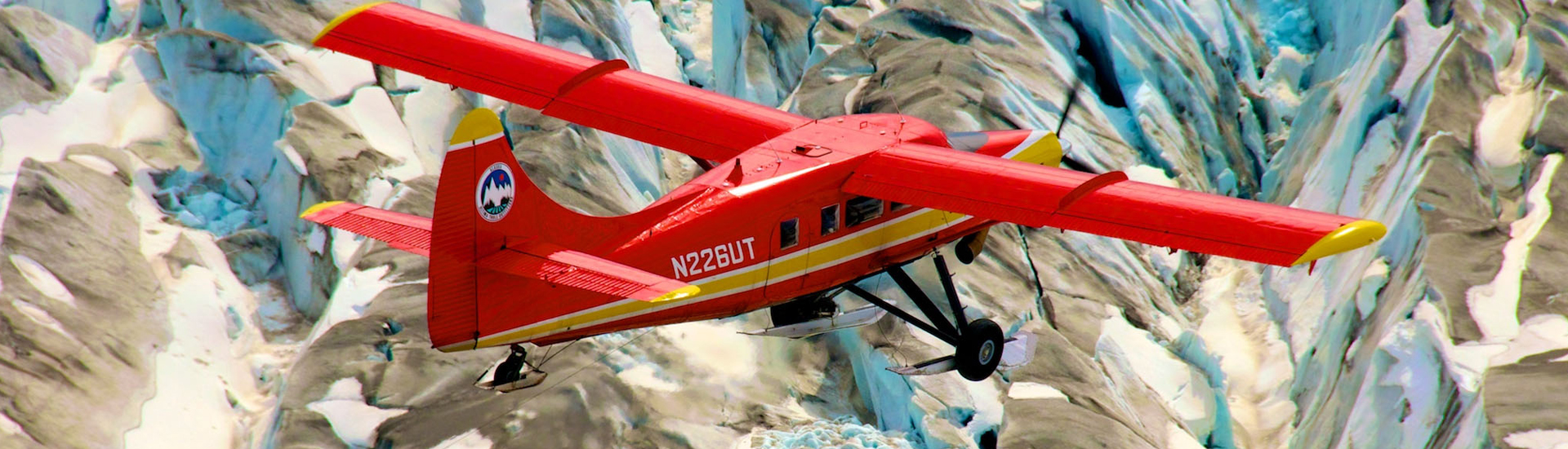
The highest mountain range in North America dominates the landscape south of our campus in Fairbanks. These mountains often remind us that Alaska is one of the most geologically active regions of the Earth--and a great place to study geology and geophysics. Scientists in our department are studying the formation of these mountains, the mechanics of earthquakes, volcanoes, glaciers and the age and distribution of different rock types across Alaska and other regions. We use these studies to reconstruct Alaska's ancient geological history and to identify geological hazards and resources.
As an undergraduate major in our department, you'll become a part of our teaching and research team. We have a strong program with about 40 undergraduate geology majors. It is a close-knit group that shares a great enthusiasm for geology and for Alaska. We offer a broad curriculum of courses that will prepare you for a career in the earth sciences or further graduate training. In small upper division classes, you'll get to know our professors well and interact with our graduate students. As you progress toward your degree, you'll find many opportunities to participate in ongoing research projects. Most of our graduates go on for advanced degrees or find employment in private industry, government or educational institutions.
Our department is in the Reichardt Building on the UAF campus. We have excellent, state-of-the-art classrooms, laboratories, computer facilities and study areas to support your education. The departments of Physics and Chemistry are also located in the building. Our students take a range of courses from these departments in support of their scientific education.
The University of Alaska is an exciting place to study geology and geophysics. I hope you decide to join us next fall.
Sincerely,
Dr. Paul Layer
Department of Geology and Geophysics
|
B.S. Geology |
B.S. in Geology: Graduates in Geology have broad
backgrounds in the earth sciences and firm foundations in mathematics, physics
and chemistry. The suggested curriculum is intended to be flexible enough to
allow students to pursue their own emphases in the junior and senior years.
The bachelor's degree prepares students for positions with industry or government,
or for graduate studies.
Expected outcomes:
The B.S. program in Geology strives to produce graduates who:
- are knowledgeable about basic geoscience concepts;
- can compete in the job market;
- are able to communicate through effective writing and speaking;
- can think critically about the important scientific issues of the
day.
|
|
|
|
B.A. Earth Science |
|
B.A. in Earth Science: This program provides
broad training in various aspects of earth science. It is especially applicable
to those wishing to teach earth science or who are entering a field such as
resource management where broad training in earth science is important.
Expected outcomes:
The BA program in Earth Science strives to produce graduates who:
- have a broad knowledge in various basic geoscience concepts;
- can compete in the job market, especially as teachers;
- are able to communicate through effective writing and speaking;
- can think critically about the important scientific issues of the
day.
|
|
|
Undergraduate/Graduate courses in Geology and Geophysics
Admissions Information |
Undergraduate Opportunities |
During the course of a B.S. or B.A. program, students
are encouraged to participate in undergraduate research or teaching, attend
department seminars and use departmental facilities. |
|
Undergraduate Research and Internships: Probably
the biggest opportunity for undergraduate students at UAF is the ability to
participate in research. We feel that our strong research component distinguishes
us over other more teaching-oriented universities. There are many opportunities
to work in labs for credit and/or pay. The department offers GEOS 488, Undergraduate
Research. Students may work with any Geology and Geophysics Faculty member on
a research project of mutual design. If the student is working with another
Geoscience professional (e.g. at the ADGGS, with Alaska Volcano Observatory
or elsewhere in the GI), then that person can serve as co-instructor. Depending
on the level of work, students may enroll for 1 - 3 credits. Students are required
to present the results of the study in the form of a written and/or oral presentation. This report can be submitted as part of another class (e.g., GEOS 475). The
length and scope of the report will depend to some extent on the number of credits
for which the student is enrolled. Please contact the department office for
additional information. GEOS 488 Undergraduate Research Form |
Undergraduate Research and Internships: Probably
the biggest opportunity for undergraduate students at UAF is the ability to
participate in research. We feel that our strong research component distinguishes
us over other more teaching-oriented universities. There are many opportunities
to work in labs for credit and/or pay. The department offers GEOS 488, Undergraduate
Research. Students may work with any Geology and Geophysics Faculty member on
a research project of mutual design. If the student is working with another
Geoscience professional (e.g. at the ADGGS, with Alaska Volcano Observatory
or elsewhere in the GI), then that person can serve as co-instructor. Depending
on the level of work, students may enroll for 1 - 3 credits. Students are required
to present the results of the study in the form of a written and/or oral presentation. This report can be submitted as part of another class (e.g., GEOS 475). The
length and scope of the report will depend to some extent on the number of credits
for which the student is enrolled. Please contact the department office for
additional information. |
Undergraduate Teaching Associates: Upper
division undergraduates are encouraged to take part in the Teaching Associate
program. This program offers students the opportunity to work with introductory
geology students and is an excellent way to practice what you have learned. Students should enroll in 1 credit of GEOS 497. The teaching associate will work with a Graduate student in a
100-level GEOS laboratory section. For more information, please see Paul Layer
(7565) or Rainer Newberry (6895). |
Special Topics Courses and Independent Study: The department regularly offers special topics courses that do not appear in
the catalog. These are generally one-time-only offerings on a topic of interest
to faculty and students and are designated as GEOS 492. Students should contact
the department or the registration handbook for courses offered in each semester. In addition to research and teaching associates, other independent study opportunities
are available with professors. These may include participation in a regularly
scheduled graduate class. Contact the department or faculty member for more
information. |
Department Seminar: The Department
offers a weekly seminar on Fridays at 3:30 PM in room 201 Natural Sciences. Students may enroll in GEOS 482 to receive credit for attending the seminars,
however all students are encouraged to attend. Speakers in the series are chosen
to discuss their research, employment opportunities and experiences or current
events in the geosciences. The level of the presentations can vary, however
students with as little as a GEOS 101 background are encouraged to attend. Seminar notices are posted around the department and can also be found on the
department web page.
Friday Seminar Schedule |
Geoscience Club: The mission
of the UAF Geoscience Club is to support and enhance educational, social, and
recreational opportunities for all UAF graduate and undergraduate geoscience
students. In addition, they provide a link between the community, professionals,
and students. Geoscience classrooms and offices are scattered across the UAF
campus and the Fairbanks area. The Geoscience Club provides social and informational
links between students at the Natural Science Facility, the Geophysical Institute,
the UAF Museum, the Alaska Division of Geological and Geophysical Surveys, and
the U.S. Geological Survey.
Geoscience Club |
Undergraduate Study Room: Room
314 has been set aside for undergraduate student use. While you are in the
Natural Sciences Facility, feel free to use this study room. It is also a good
place to find out what is going on with the Geoscience Club, other activities,
and seminars. Advertisements for field camps, other graduate schools and employers
seeking students are also posted here. |
Computer Laboratory: Room
316 is the department computer laboratory. Access to the facility is reserved
for majors and students enrolled in Geology and Geophysics upper division courses. Please contact the department for information about accounts and access.
Computer Lab Information |
Department Web page: The department
web page is at http://www.uaf.edu/geology and contains information about current events, course syllabi, seminar notices
and faculty and student web pages. Please contact the department if you would
like to contribute to the pages. |
Field Camp: The department
offers a 6-week summer field course in alternate years. The next offering will
be Summer 2005. Please contact the department office for additional information. If you need to attend field camp in the summer of 2004 please see Paul Layer
or Rainer Newberry for assistance. It is important that you get "pre-approval"
of the camp that you plan to attend in order to avoid problems in transferring
credit.
Field Camp Information and Schedule |
State-of-the-Art Laboratories
and Classrooms: Opened in 1995, the Natural
Sciences building houses natural science programs and laboratories with the
geology and geophysics program occupying over 30% of the building. The building
has three "smart" classrooms that enable instructors to use computer simulations,
multimedia and video as part of the instructional program. Six laboratory rooms
are dedicated to geology instruction. Undergraduates may also use state-of-the-art
computer facilities as part of the learning experience. Senior level undergraduates
are also encouraged to participate in introductory geology laboratories as "teaching
associates" for credit. It is a great way for our students to put their geologic
knowledge to the test through instruction of younger students.
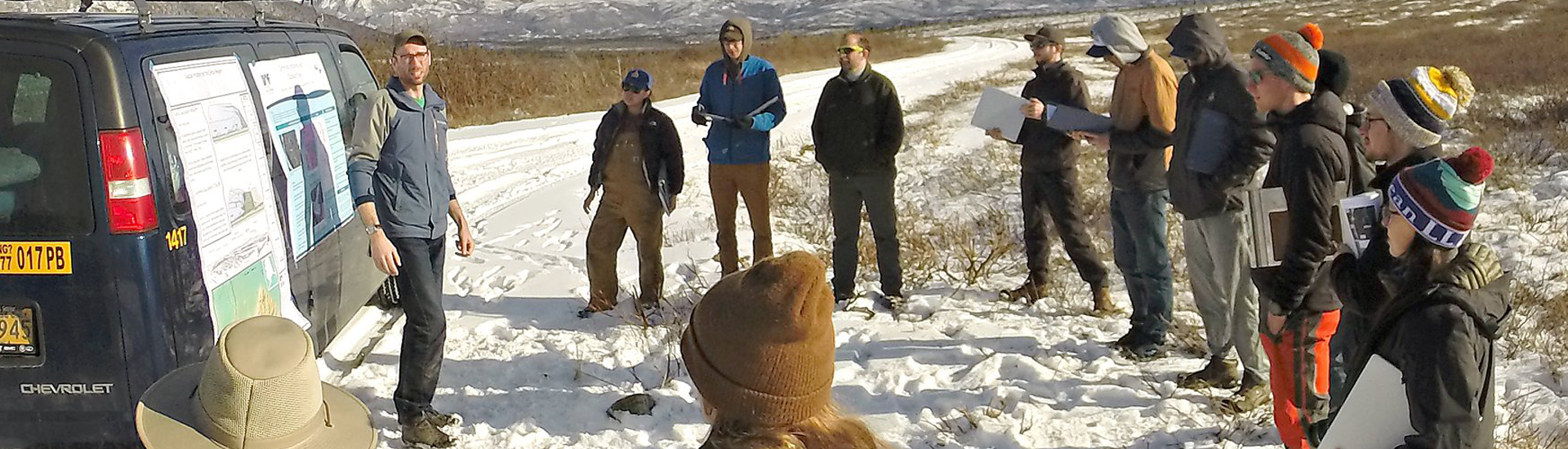
Although not strictly a "laboratory" or "classroom",
Alaska is the best teaching facility that we have. Field trips are a regular
part of our instructional curriculum, and a 6-week summer field program is a
requirement for the B.S. degree. In recent years this field program has taken
students to some of the most remote areas of the state, accessible only by small
aircraft or off-road vehicles. In this wilderness setting, students receive
first hand exposure to the geology of Alaska and receive instruction in field
methods under the supervision of our faculty. |
Research Facilities: Undergraduate
students are encouraged to participate in the research activities in the department. Working side-by-side with faculty and research staff, students learn "how science
works". This research can be the source of student employment and can lead
to senior theses, published scientific papers, or presentations at conferences.
The Natural Science Facility
houses many analytical and research laboratories. Facilities include an electron
microprobe, scanning electron microscope, high temperature/pressure experimental
petrology laboratory, a geochronology laboratory and a paleomagnetics laboratory. Other facilities housed at the Geophysical Institute include the Alaska Earthquake
Information Center (AEIC) which operates a 100+ station seismic network in the
state, the Alaska Volcano Observatory (AVO) which monitors Alaska's many active
volcanoes, and the Alaska Synthetic Aperture Radar (SAR) Facility (ASF) which
provides data for sea ice studies and other geophysical investigations. The
UAF museum has extensive collections of geological, biological and anthropological
specimens that are actively used in research by our faculty members.
Alaska occupies a unique position in the Arctic,
and UAF has remote field research facilities located throughout the state. At these stations, research projects in the fields of snow, ice and permafrost
are carried out. There are opportunities for undergraduates to be involved
in these areas of research, which actively monitor our changing climate.
Opportunities are also available for summer
research experience at the Geophysical Institute or at other universities throughout
the United States. |
Professional and Social Activities: Faculty
members are active in the Geological Society of America, the American Geophysical
Union, the Society of Economic Geologists, the American Association of Petroleum
Geologists and the Alaska Geological Society. Student membership in these organizations
is available and students are encouraged to join. In addition, all undergraduate
and graduate students are members of the UAF Geoscience Club, which plans field
trips, seminars and other activities. |
Graduate Success: Our
graduates are employed in a variety of private and public sector jobs in Alaska
and elsewhere. Although many are involved in the mining and petroleum industries
as geologists, some are also employed as corporate executives, private consultants,
research scientists, professors, and government regulators. Recent graduates
are enrolled in graduate programs at the University of Washington, the University
of Oklahoma, Australia National University, the University of Wisconsin, the
University of Georgia, the University of Massachusetts, UAF and other institutions. |
|