
Languages: Where it all begins and ends.
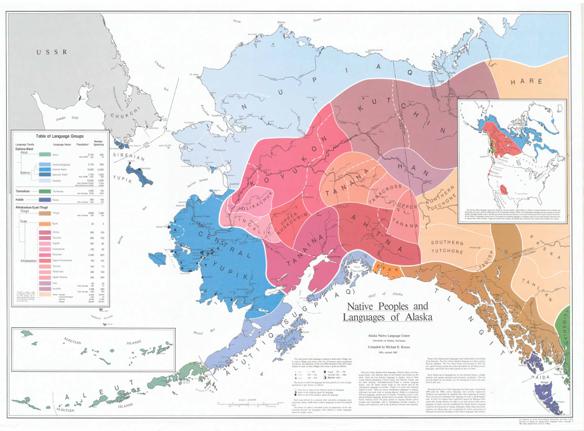
Alaska is the original home of two great American language families, Eskimo-Aleut and Athabascan -Eyak-Tlingit. Both families have spread far beyond Alaska with Eskimo-Aleut through Canada to Greenland and parts of Athabascan-Eyak-Tlingit almost to Mexico. In both cases, not only is the population greater at the extremes, but also the number of children speakers of these languages, who are the future of these languages. With the sole exception of Central Alaskan Yup'ik (St. Lawrence Island Yup'ik-minimal use of adolescents), presently, there are no children speaking any of the other Native languages in Alaska (or nearby Chukotka or Yukon Territory).
This project focuses on the lexical documentation of this acutely endangered diversity.Prioritization is on lexicon in part because the Principal Investigator, Michael Krauss believes that lexicon is less structured or cohesive than grammar, so it is more difficult to document comprehensively and easier to forget. Dictionaries that include affixes, and textural examples, will document more grammar than good grammar will document lexicon, especially for these Alaskan languages, all highly polysynthetic.
The proposed activities meet the Education and Outreach goals for the International Polar Year. These languages represent unique and critical components of the Arctic environment. All of these languages are endangered, and argueably, more so than any other aspect of these cultures. Compounding this issue is that in most cases, the researchers in this proposal are the sole experts in their field and are at retirement age and well beyond.
Finally, the project will produce comprehensive and definitive works including dictionaries and other resources for many languages of the Arctic. There will be assorted publications and web-based resources for these languages. This body of work could be used in, most importantly, in the development of curriculum for community language restoration programs and in the scientific preservation of these languages.